Catalogue > Liste par artiste
Parcourez la liste complète des artistes présentés dans le cadre des Rencontres Internationales depuis 2004. Utilisez le filtre alphabétique pour affiner vos recherches.
Miljana Nikovic
Catalogue : 2021Two Simple Letters | Vidéo | mov | couleur | 2:34 | Serbia, Allemagne | 2020
Miljana Nikovic
Two Simple Letters
Vidéo | mov | couleur | 2:34 | Serbia, Allemagne | 2020
Mars 2020. Dans un monde compliqué et apocalyptique, que se passe-t-il si votre esprit est égoïstement obsédé par votre vie amoureuse? Si vous commencez à chercher des amants potentiels sur des sites de rencontre? Si la plupart d'entre eux ne réagissent pas à vos messages (bien que vous puissiez voir qu’ils sont en ligne), probablement pas assez stimulés par votre profil? D'autres conviendraient peut-être d'une promenade, s'il ne pleut pas, samedi après-midi ou mardi prochain. Cela ne semble pas très prometteur. Presque toujours, la communication s'arrête sans raison évidente, même si tout le monde reste en ligne. L'attention et la curiosité disparaissent. Est-ce que toutes ces conversations resteront des fantasmes virtuels? Était-ce différent avant le confinement? Grâce à Internet, les écrans multipliés sont nos nouvelles fenêtres fragmentées sur le monde extérieur. En contact avec n'importe qui, n'importe où, n'importe quand. Mais isolés: seuls et solitaires dans une pièce. Ce poème vocal et visuel consiste en une déconstruction des courtes phrases que l'on utilise pour arranger un rendez-vous avec un inconnu. Hésitantes et polies, "Two Simple Letters" ("deux simples lettres") évoquent une insécurité permanente, une modestie, une timidité - pour éviter d'offenser ou d'effrayer son ou ses interlocuteurs. L’utilisation consciente d'éléments pop ludiques, tant au niveau des effets sonores que des couleurs, permet d'alléger cette situation auto-dérisoire.
Miljana Nikovic est architecte et chercheuse. Elle expérimente par la vidéo, la photographie, le son, le collage et l'écriture. Née à Belgrade (Serbie), elle vit à Berlin (Allemagne). Après avoir obtenu une Licence à l’École nationale supérieure d'architecture de Nancy (France) en 2013, et un Master à la Hochschule für Technik, Wirtschaft und Kultur Leipzig (Allemagne) en 2015, elle a travaillé dans le domaine de la stratégie des espaces de travail, et comme coordinatrice de projet. Elle entame actuellement un doctorat archivistique-artistique à l'Université HafenCity, Hambourg (Allemagne). Il porte sur les parallèles entre les villes, le cinéma et les perceptions historiques des souvenirs collectifs. Elle a récemment fondé un collectif de poètes francophones, et a été sélectionnée dans des festivals internationaux de cinéma avec son court métrage expérimental "Seven Seven" et le vidéo-poème "La Rive Virale" [Los Angeles (USA), Mexico (Mexique), Athènes (Grèce)].
Natacha Nisic
Catalogue : 2023The Crown letter | Film expérimental | digital | couleur | 50:0 | France | 2022
Natacha Nisic
The Crown letter
Film expérimental | digital | couleur | 50:0 | France | 2022
The Crown Letter The Crown Letter is an international collective of women artists. It was founded by Natacha Nisic in April 2020, in response to the first wave of the coronavirus pandemic. Natacha Nisic created this art project to respond to a needandsupport women artists at a time when their lives, their networks and the visibility of their work were particularly disrupted. Beyond the circumstances that gave birth to it, The Crown Letter has become a fertile, organic, self-managed and independent space for creation and dialogue, crystallizing the lack of such openings to creation and the encounter of women artists. From the beginning, the artists have published a new edition of The Crown Letter online every week, with the works of many international contributors. These works reflect our current times through drawing, sculpture, photography, collage, writing, sound and video. In 2022, Natacha Nisic received the Hans und Lea Gründig Preis for the project in Berlin. Fluxus Art Project has promoted the project in 2022.
Exhibitions 2020 - Publication of the website 2021 - Photodays Paris, outdoor exhibitions at the square Chatelet and Vuillemin garden, Paris. Hyperfestival. - Fondation Fiminco, Photodays 2022 - KG+, French Institut Kyoto, Japan - Bienal Sur, Centro Cultural Cordoba - MAPI, Montevideo, Uriguay 2023 - Residencie at Luxfer, in Ceska Skalice, Czech Republic - We will want to dance tomorow. Tales for the future, Galerie 35, Institut Français, Prague Publication 2021 - Trigger magazine 3, "Care" - Moving Image Review and Art Journal, Volume 9, Number 2, London
Natacha Nisic
Catalogue : 2010Le textile est mort mais les gens vivent encore | Doc. expérimental | 16mm | couleur | 11:6 | France | 2008

Natacha Nisic
Le textile est mort mais les gens vivent encore
Doc. expérimental | 16mm | couleur | 11:6 | France | 2008
Natacha Nisic, en collaboration avec Ken Daimaru
Catalogue : 2022Saint-Désir l'Exil | Vidéo | mov | couleur | 9:15 | France | 2020
Natacha Nisic
Saint-Désir l'Exil
Vidéo | mov | couleur | 9:15 | France | 2020
Au coeur de Saint-Désir l'Exil se trouve une piscine. Au coeur de la piscine se trouvent les corps nocifs. A côté de la piscine, ma maman vit ses derniers instants sous le soleil.
Natacha Nisic,born in 1967 in France. Studies at Ecole Nationale Supérieure des Arts Décoratifs of Paris (1986-90) and at the Deutsche Film und Fernseh Akademie of Berlin (1989-91), and at the Fémis, Paris. Natacha Nisic continually explores the invisible, even magical relationship between images, words, interpretation, symbol and ritual. Her work interweaves links between stories, accounts of the past and the present, to reveal the complexities of the relationship between what is shown and what is hidden, the spoken and the unspoken. Her fixed and moving images function as substrata of memory, memory torn between its value as proof and its loss, and are all statements about the status of images and the possibilities of representation. She exposed in France, Japan, Italy, Germany, Spain, United Kingdom, Korea and Argentina. Her most notable personal exhibitions in Paris (France) are Haus/raus-aus (Le Plateau, Frac Ile-de-France), Effroi (Musée Zadkine), La porte de Birkenau (Mémorial de la Shoah) Nord, Carmel (Centre Georges Pompidou), and Echo (Galeries nationales du Jeu de Paume). Abroad : KW Complex (Atelier Hermès, Seoul, Korea), Trying to land (MACRO, Rome, Italy), Loop Barcelona (Dominique Fiat, Barcelone, Spain). She has participated in several group exhibitions in France and abroad, such as Regard fatigué (with Christophe Marchand-Kiss, Schloß Solitude, Stuttgart, Germany, 1998), Contemporary Utopia (Centre d’art contemporain Letton, Riga, LT, 2001), Tempered Ground (Museum of Garden History, Londres, UK, 2004), elles@centrepompidou, les artistes femmes de la collection du Mnam ( Centre Georges Pompidou, FR, 2009), Yebisu international festival for new vision tokyo (Metropolitan Museum of Photography, JP, 2010), and Immigrantes in Arte Contemporeano (Munfret, curator Diana Wechsler, Buenos Aires, AR, 2015). She won almost 10 grants, among the Arbeitstipendium (Senatsverwaltung für Wissenschaft, Forschung und Kultur, Berlin, Germany). She also stayed at the Villa Medici (Rome, Italy, 2007) and two times at the Villa Kujoyama Duo (Japan, 2001 ; 2016).
Catalogue : 2019Osoresan | Vidéo | hdv | couleur | 17:15 | France, Japon | 2018
Natacha Nisic, en collaboration avec Ken Daimaru
Osoresan
Vidéo | hdv | couleur | 17:15 | France, Japon | 2018
OSORESAN Natacha Nisic & Daimaru Ken 3 channels installation, stereo sound, 17’, 2018 The Itako are women who train to become spiritual mediums in Northeast region of Japan and to evoke departed spirits for the living seeking to communicate with the dead. Most of them have visual disabilities and learn language and rites to describe a rich spiritual world entirely through oral communication. Our first meeting wit Nakamura Take took place in Hachinohe city in Jully 2015. Fiming a blind person is a challenge, in one hand, we would see what she would never share with us, and on the other hand, it seems that she « sees » things that we aslo don’t see. We met her two times in 2015 and in 2017. Each sequence was very short between clients who were regularely knocking at her door. Those fragments of her life, moments of remembering songs, rites and legends were too short to build up a large portrait. They became elements of a constellation we wanted to draw : balancing her humility and modesty versus the huge scale of the desaster which happened not so far fom a living region. Her way to travel in unknown countries of dead and spirits, using a treasure of words, notes, incantation, has been guiding own journey into the landscapes revealing the traces of the post catastrophy. (imprégnant par ses paroles chacune de nos visions des paysages que nous traversions). She told us the legend of «Oshirasama», the founding tail for Itakos, a cruel story of a father, a beloved daughter and a horse. As we crossed the city of Soma, we remembered the Horse Festival organized by the city just one year after the disaster. The horses are still there, waiting. The desire to make peace with the dead motivates each one visiting an Itako. What could help us to make our own peace with the heritage of the post catastrophy ? What kind of political individual gestures could face the large scale of political environmental decisons ? We still have to deal wih nuclear threat. As a symbol of fear, the mount Osoresan, a lansdcape of ashes, smoke and dark water, responds to the hyptnotic beauty of the fragmentation of alpha an beta rays displayed at the Rokkasho PR Center. Fear, to be acclimated must show a fascinating face, as Itakos used to be represented ; stranges, unreachable and dangerous figures of women. Witches. We discovered a touching, smily, opened woman. We realized that Take Nakamura is a monument of Japan history. Very precious, rare and fragile. With participation of Take Nakamura and Itakos of Osorezan Cast: Satoko Abe, Fumie Kubota, Yohei Kobayashi, Kyoko Takenaka, Mika Shigemori
Catalogue : 2011e | Doc. expérimental | 0 | couleur | 20:0 | France | 2010
Natacha Nisic
e
Doc. expérimental | 0 | couleur | 20:0 | France | 2010
− e est le récit d`un voyage dans le nord du Japon à la recherche d`un territoire inaccessible : un territoire transformé, meurtri par un tremblement de terre d`intensité 6,7 sur l`échelle de Richter en juin 2008. La montagne déplacée, ouverte en quelques minutes par le choc violent des éléments, est une cicatrice ouverte d`une étrange beauté dont le sort reste indéterminé Cette cicatrice qui ne peut se refermer, reste un paysage d`une grande beauté, un grand canyon qui pourrait devenir un parc d`attraction, un « ecopark » qui attirerait les touristes, faisant de la catastrophe un argument de vente, .. − Nous survolons ce territoire, tentons d`y accéder malgré les barrages qui le clôturent. Ne peuvent y accéder que les camions des travailleurs à la reconstructions et les résidents reclus. Ceux qui ont vécu le tremblement de terre racontent et rejouent ces instants violents. Apprivoiser la catastrophe est une attitude culturelle japonaise. Si on ne peut apprivoiser le futur, on peut le prévenir.
Née en 1967 à Grenoble, Natacha Nisic poursuit des études d`art à l`ENSAD de Paris, et de cinéma à DFFB de Berlin et à la Femis. Son travail se situe à la frontière des différents supports de l`image en mouvement, Super 8, film et vidéo, mais aussi par la photographie et l`installation. Elle réalise de nombreuses expositions en France, Printemps de Cahors, Centre National de la Photographie, Le plateau-Frac Ile-de-France. Ses films ont été récemment présentés au Centre Georges Pompidou à Paris, K21, Düsseldorf, Metropolitan Museum of Photography, Tokyo, British Film Institute, Londres.
Catalogue : 2010Le textile est mort mais les gens vivent encore 1 | Doc. expérimental | super16 | couleur | 5:47 | France | 2009
Natacha Nisic
Le textile est mort mais les gens vivent encore 1
Doc. expérimental | super16 | couleur | 5:47 | France | 2009
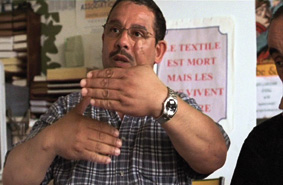
L`usine Desurmond à Tourcoing a fermé en 2004. C`était la dernière usine de filature de cette région. Les ouvriers se sont regroupés en association afin de faire valoir leurs droits et créer une communauté, au delà de la perte du travail. Les hommes puis les femmes ont reproduits la chaine et les gestes du travail à la chaine dans cette filature. Certains y ont travaillés en équipe de nuit pendant 35 ans.
Née en 1967. Ecole Nationale Supérieure des Arts Décoratifs de Paris, poursuit des études à la Deutsche Film und Fernseh Akademie de Berlin et à la Femis à Paris pour l`écriture de scénario. Elle réalise de nombreuses expositions et films où la question de l`image est mise en jeu. Elle utilise pour cela différents médiums : super 8, 16 mm, vidéo, photographie. Images fixes ou en mouvement fonctionnent comme substrat de la mémoire, mémoire tendue entre sa valeur de preuve et sa perte. Les différentes expositions personnelles comme au Plateau, Frac île de France, puis au musée Zadkine à Paris, sont des autant de prises de positions sur le statut des images et les possibles de la représentation.Ces oeuvres ont été montrées dans de nombreux pays, Allemagne, Espagne, Japon, Corée, canada, Argentine... Ses films sont diffusés sur Arte et au Centre Georges Pompidou à Paris. Pensionnaire de la Villa Kujoyama (2001) et Villa médicis (2007).
Catalogue : 2010Le textile est mort mais les gens vivent encore 2 | Doc. expérimental | super16 | couleur | 5:20 | France | 2009
Natacha Nisic
Le textile est mort mais les gens vivent encore 2
Doc. expérimental | super16 | couleur | 5:20 | France | 2009
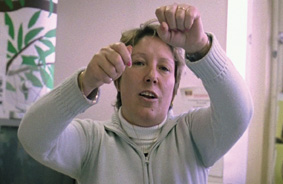
voir ouvrier 1
Voir ouvrier 1
Natacha Nisic
Catalogue : 2023Et n'être que brume | Film expérimental | 0 | couleur | 15:0 | France | 2023
Natacha Nisic
Et n'être que brume
Film expérimental | 0 | couleur | 15:0 | France | 2023
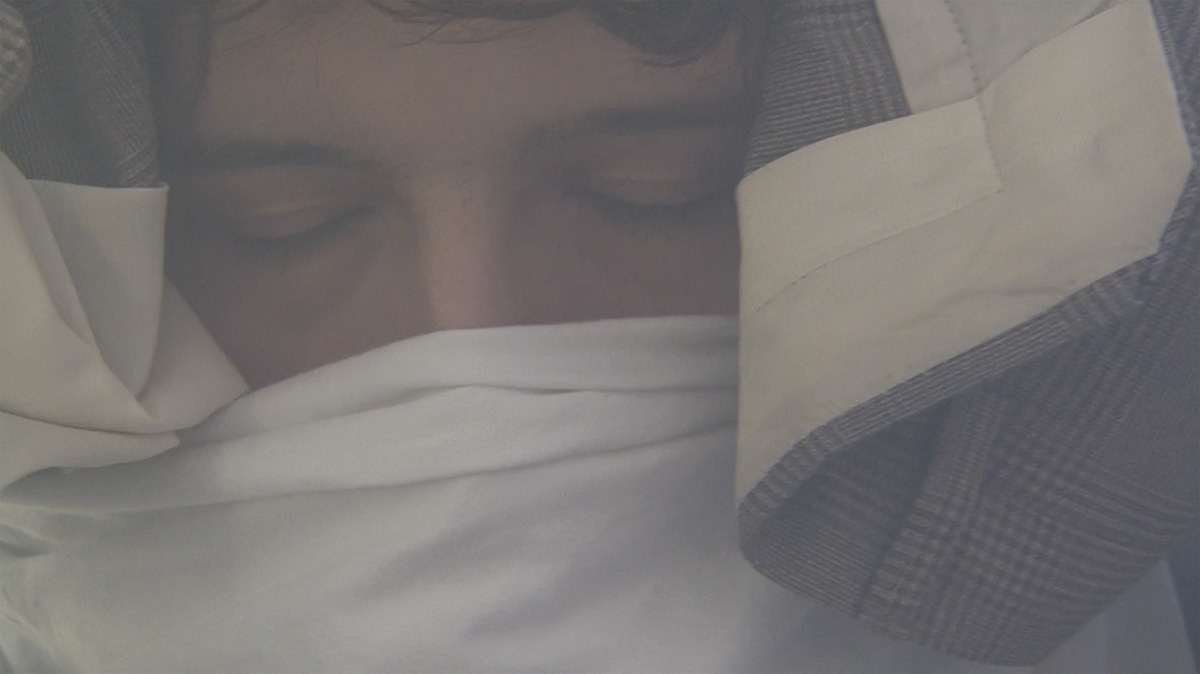
Dans la tour de la ville de Malakoff "Et n’être que brume » met en place le cadre expérimental d’une improvisation.Plongés dans les brumes, les êtres se révèlent. L’écran de la fumée permet une libération des affects car au sein du brouillard se logent les souvenirs, les torpeurs et les désirs. Le film est en hommage à la Crimée annexée depuis 2014 par la Russie.
Natacha Nisic is an artist and filmmaker. She weaves links between history, representation and memory and its implications in the political, social and cultural fields. She explores the invisible relationship between images, words, interpretation, symbol and ritual. Her work questions the nature of the image through different media: Super 8, 16MM, video, photography and drawing. She created The Crown Letter (2020), an international platform of women artists, in response to the Corona virus crisis. She directed “Rather Die Than Die” (2018) a documentary essay on the First World War and the art historian Aby Warburg as part of the commemorations of the Centenary of the First World War, and, for Arte, “Andrea’s Sky” (2014) on a Bavarian shaman initiated in South Korea. Natacha Nisic exhibits worldwide — recent exhibitions include, MNAV, Uruguay, 2023, Frise, Hambourg(2023), Leopold Hoesch Museum (2022), Centre Pompidou (2020), Sharjah Film Platform (2019), the Yebisu Film Festival, Tokyo (2018), the Media City Biennale in Seoul (2016), Bienal de la Imagen en mouvement in Buenos Aires, Munfret in Buenos Aires (2016). In 2014, about his highly acclaimed solo exhibition, Echo at the Jeu de Paume in Paris, the Art Press newspaper writes “His work offers a mediation on cultural differences, on the necessary struggle to consolidate memory against oblivion”. Natacha Nisic created the Children’s Memorial at the Shoah Memorial in Paris in 2005, questioning the question of the monument and its evolution over time. Nisic has obtained numerous scholarships and residencies, notably at the Villa Kujoyama, Tokyo in 2001 and 2016, at the Gyeonngi Creation Center, South Korea (2010) and at the Villa Medici, Rome in 2007. Education: Ecole Nationale Supérieure des Arts Décoratifs, Paris; Deutsche Film und Fernseh Akademie, Berlin; La Femis, Paris. Born in Grenoble, France, in 1967.
Natacha Nisic
Catalogue : 2022Saint-Désir l'Exil | Vidéo | mov | couleur | 9:15 | France | 2020
Natacha Nisic
Saint-Désir l'Exil
Vidéo | mov | couleur | 9:15 | France | 2020
Au coeur de Saint-Désir l'Exil se trouve une piscine. Au coeur de la piscine se trouvent les corps nocifs. A côté de la piscine, ma maman vit ses derniers instants sous le soleil.
Natacha Nisic,born in 1967 in France. Studies at Ecole Nationale Supérieure des Arts Décoratifs of Paris (1986-90) and at the Deutsche Film und Fernseh Akademie of Berlin (1989-91), and at the Fémis, Paris. Natacha Nisic continually explores the invisible, even magical relationship between images, words, interpretation, symbol and ritual. Her work interweaves links between stories, accounts of the past and the present, to reveal the complexities of the relationship between what is shown and what is hidden, the spoken and the unspoken. Her fixed and moving images function as substrata of memory, memory torn between its value as proof and its loss, and are all statements about the status of images and the possibilities of representation. She exposed in France, Japan, Italy, Germany, Spain, United Kingdom, Korea and Argentina. Her most notable personal exhibitions in Paris (France) are Haus/raus-aus (Le Plateau, Frac Ile-de-France), Effroi (Musée Zadkine), La porte de Birkenau (Mémorial de la Shoah) Nord, Carmel (Centre Georges Pompidou), and Echo (Galeries nationales du Jeu de Paume). Abroad : KW Complex (Atelier Hermès, Seoul, Korea), Trying to land (MACRO, Rome, Italy), Loop Barcelona (Dominique Fiat, Barcelone, Spain). She has participated in several group exhibitions in France and abroad, such as Regard fatigué (with Christophe Marchand-Kiss, Schloß Solitude, Stuttgart, Germany, 1998), Contemporary Utopia (Centre d’art contemporain Letton, Riga, LT, 2001), Tempered Ground (Museum of Garden History, Londres, UK, 2004), elles@centrepompidou, les artistes femmes de la collection du Mnam ( Centre Georges Pompidou, FR, 2009), Yebisu international festival for new vision tokyo (Metropolitan Museum of Photography, JP, 2010), and Immigrantes in Arte Contemporeano (Munfret, curator Diana Wechsler, Buenos Aires, AR, 2015). She won almost 10 grants, among the Arbeitstipendium (Senatsverwaltung für Wissenschaft, Forschung und Kultur, Berlin, Germany). She also stayed at the Villa Medici (Rome, Italy, 2007) and two times at the Villa Kujoyama Duo (Japan, 2001 ; 2016).
Catalogue : 2019Osoresan | Vidéo | hdv | couleur | 17:15 | France, Japon | 2018
Natacha Nisic, en collaboration avec Ken Daimaru
Osoresan
Vidéo | hdv | couleur | 17:15 | France, Japon | 2018
OSORESAN Natacha Nisic & Daimaru Ken 3 channels installation, stereo sound, 17’, 2018 The Itako are women who train to become spiritual mediums in Northeast region of Japan and to evoke departed spirits for the living seeking to communicate with the dead. Most of them have visual disabilities and learn language and rites to describe a rich spiritual world entirely through oral communication. Our first meeting wit Nakamura Take took place in Hachinohe city in Jully 2015. Fiming a blind person is a challenge, in one hand, we would see what she would never share with us, and on the other hand, it seems that she « sees » things that we aslo don’t see. We met her two times in 2015 and in 2017. Each sequence was very short between clients who were regularely knocking at her door. Those fragments of her life, moments of remembering songs, rites and legends were too short to build up a large portrait. They became elements of a constellation we wanted to draw : balancing her humility and modesty versus the huge scale of the desaster which happened not so far fom a living region. Her way to travel in unknown countries of dead and spirits, using a treasure of words, notes, incantation, has been guiding own journey into the landscapes revealing the traces of the post catastrophy. (imprégnant par ses paroles chacune de nos visions des paysages que nous traversions). She told us the legend of «Oshirasama», the founding tail for Itakos, a cruel story of a father, a beloved daughter and a horse. As we crossed the city of Soma, we remembered the Horse Festival organized by the city just one year after the disaster. The horses are still there, waiting. The desire to make peace with the dead motivates each one visiting an Itako. What could help us to make our own peace with the heritage of the post catastrophy ? What kind of political individual gestures could face the large scale of political environmental decisons ? We still have to deal wih nuclear threat. As a symbol of fear, the mount Osoresan, a lansdcape of ashes, smoke and dark water, responds to the hyptnotic beauty of the fragmentation of alpha an beta rays displayed at the Rokkasho PR Center. Fear, to be acclimated must show a fascinating face, as Itakos used to be represented ; stranges, unreachable and dangerous figures of women. Witches. We discovered a touching, smily, opened woman. We realized that Take Nakamura is a monument of Japan history. Very precious, rare and fragile. With participation of Take Nakamura and Itakos of Osorezan Cast: Satoko Abe, Fumie Kubota, Yohei Kobayashi, Kyoko Takenaka, Mika Shigemori
Catalogue : 2011e | Doc. expérimental | 0 | couleur | 20:0 | France | 2010
Natacha Nisic
e
Doc. expérimental | 0 | couleur | 20:0 | France | 2010
− e est le récit d`un voyage dans le nord du Japon à la recherche d`un territoire inaccessible : un territoire transformé, meurtri par un tremblement de terre d`intensité 6,7 sur l`échelle de Richter en juin 2008. La montagne déplacée, ouverte en quelques minutes par le choc violent des éléments, est une cicatrice ouverte d`une étrange beauté dont le sort reste indéterminé Cette cicatrice qui ne peut se refermer, reste un paysage d`une grande beauté, un grand canyon qui pourrait devenir un parc d`attraction, un « ecopark » qui attirerait les touristes, faisant de la catastrophe un argument de vente, .. − Nous survolons ce territoire, tentons d`y accéder malgré les barrages qui le clôturent. Ne peuvent y accéder que les camions des travailleurs à la reconstructions et les résidents reclus. Ceux qui ont vécu le tremblement de terre racontent et rejouent ces instants violents. Apprivoiser la catastrophe est une attitude culturelle japonaise. Si on ne peut apprivoiser le futur, on peut le prévenir.
Née en 1967 à Grenoble, Natacha Nisic poursuit des études d`art à l`ENSAD de Paris, et de cinéma à DFFB de Berlin et à la Femis. Son travail se situe à la frontière des différents supports de l`image en mouvement, Super 8, film et vidéo, mais aussi par la photographie et l`installation. Elle réalise de nombreuses expositions en France, Printemps de Cahors, Centre National de la Photographie, Le plateau-Frac Ile-de-France. Ses films ont été récemment présentés au Centre Georges Pompidou à Paris, K21, Düsseldorf, Metropolitan Museum of Photography, Tokyo, British Film Institute, Londres.
Catalogue : 2010Le textile est mort mais les gens vivent encore 1 | Doc. expérimental | super16 | couleur | 5:47 | France | 2009
Natacha Nisic
Le textile est mort mais les gens vivent encore 1
Doc. expérimental | super16 | couleur | 5:47 | France | 2009
L`usine Desurmond à Tourcoing a fermé en 2004. C`était la dernière usine de filature de cette région. Les ouvriers se sont regroupés en association afin de faire valoir leurs droits et créer une communauté, au delà de la perte du travail. Les hommes puis les femmes ont reproduits la chaine et les gestes du travail à la chaine dans cette filature. Certains y ont travaillés en équipe de nuit pendant 35 ans.
Née en 1967. Ecole Nationale Supérieure des Arts Décoratifs de Paris, poursuit des études à la Deutsche Film und Fernseh Akademie de Berlin et à la Femis à Paris pour l`écriture de scénario. Elle réalise de nombreuses expositions et films où la question de l`image est mise en jeu. Elle utilise pour cela différents médiums : super 8, 16 mm, vidéo, photographie. Images fixes ou en mouvement fonctionnent comme substrat de la mémoire, mémoire tendue entre sa valeur de preuve et sa perte. Les différentes expositions personnelles comme au Plateau, Frac île de France, puis au musée Zadkine à Paris, sont des autant de prises de positions sur le statut des images et les possibles de la représentation.Ces oeuvres ont été montrées dans de nombreux pays, Allemagne, Espagne, Japon, Corée, canada, Argentine... Ses films sont diffusés sur Arte et au Centre Georges Pompidou à Paris. Pensionnaire de la Villa Kujoyama (2001) et Villa médicis (2007).
Catalogue : 2010Le textile est mort mais les gens vivent encore 2 | Doc. expérimental | super16 | couleur | 5:20 | France | 2009
Natacha Nisic
Le textile est mort mais les gens vivent encore 2
Doc. expérimental | super16 | couleur | 5:20 | France | 2009
voir ouvrier 1
Voir ouvrier 1
Rossella Nisio
Catalogue : 2022The Price for Fire | Animation | hdv | couleur | 18:40 | Italie, Pays-Bas | 2021
Rossella Nisio
The Price for Fire
Animation | hdv | couleur | 18:40 | Italie, Pays-Bas | 2021
Against the backdrop of a vacant house, two voices pursue the shadows of 1968 and its aftermath: Drifter, brooding over the revolution that never came, and his unnamed comrade, who addresses him from the ranks of a funeral procession. The film is based on the events surrounding the death of M.A., a left-wing activist.
Rossella Nisio is an Italian visual artist based in Rotterdam. She has a background in the theory of cinema and performing arts at the University of Roma Tre and holds an MA in Fine Art and Design from the Piet Zwart Institute in Rotterdam. Her moving image works have been shown in festivals in the Netherlands and abroad and are included in the collection of the EYE Film Institute. She is a resident artist at the Rijksakademie in Amsterdam in 2021-22.
Rossella Nisio
Catalogue : 2020The Silent Ray | Vidéo | hdv | couleur | 18:1 | Italie, Pays-Bas | 2019
Rossella Nisio
The Silent Ray
Vidéo | hdv | couleur | 18:1 | Italie, Pays-Bas | 2019
The man’s presence lingers in the room that for years served as his study. Present and past intertwine as he follows threads of his memory and recalls events from the time of his participation in the colonial war against Ethiopia in 1935-36.
Rossella Nisio [IT] is a visual artist based in Rotterdam whose work has a strong focus on notions of memory, imagination and space. She has a background in the theory of cinema and performing arts; she pursued her practical training first within the field of documentary photography, eventually moving towards a more autonomous approach to still and moving image-making. She completed the advanced photography studies in Ar.Co in Lisbon in 2017 and earned an MA in Fine Art and Design at the Piet Zwart Institute in Rotterdam in 2019.
Ana Njemoga-kolar
Catalogue : 2006Americky sen v Niznom Hrabovci | Documentaire | betaSP | couleur | 10:0 | Slovaquie | 2000
Ana Njemoga-kolar
Americky sen v Niznom Hrabovci
Documentaire | betaSP | couleur | 10:0 | Slovaquie | 2000
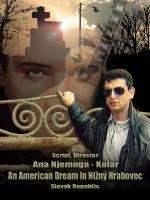
Dans un contexte de relations complexes entre la majeure partie de la population et la communauté tzigane en Slovaquie, Gabriel apparaît, jeune gitan déterminé à créer une vie culturelle dans son petit village endormi. Le village se réveille parfois, mais la seule animation a alors lieu au pub. Gabriel offre plus : sa propre musique ainsi qu'un groupe folk, faisant des danses tziganes et non tziganes. Les habitants du village le regardent avec méfiance. Que s'est-il vraiment passé, et qu?est-ce qui n?appartenait qu?au rêve ? L'histoire ne répond pas à cette question. C'est seulement un témoignage d'une tentative continuelle faite par une personne qui croit en lui-même et en son peuple.
Ana Njemoga-Kolar est née en ex-Yougoslavie. Elle vit en République Slovaque depuis 1993. Elle a apporté sa contribution à la culture des deux pays. Ses pièces ont été retransmises à la Radio Beograd, Novy Sad, Sarajevo, Ljubljana? et en République Slovaque dans les émissions de la station de diffusion Slovaque. Elle est l'auteur de nombreuses pièces de théâtre, et est également publiciste. Dans ce nouvel environnement, elle a commencé à se consacrer aux documentaires. Elle a reçu de nombreuses récompenses pour ses ?uvres documentaires et littéraires. Ana Njemoga-- Kolar prépare également d'autres projets consacrés aux thèmes de son nouvel environnement, et qui, en effet possèdent toujours une nuance humaine universelle.
Ninah Nogino
Catalogue : 2025Relato de Xerém | Doc. expérimental | 4k | couleur | 15:0 | Brésil | 2024
Ninah Nogino
Relato de Xerém
Doc. expérimental | 4k | couleur | 15:0 | Brésil | 2024
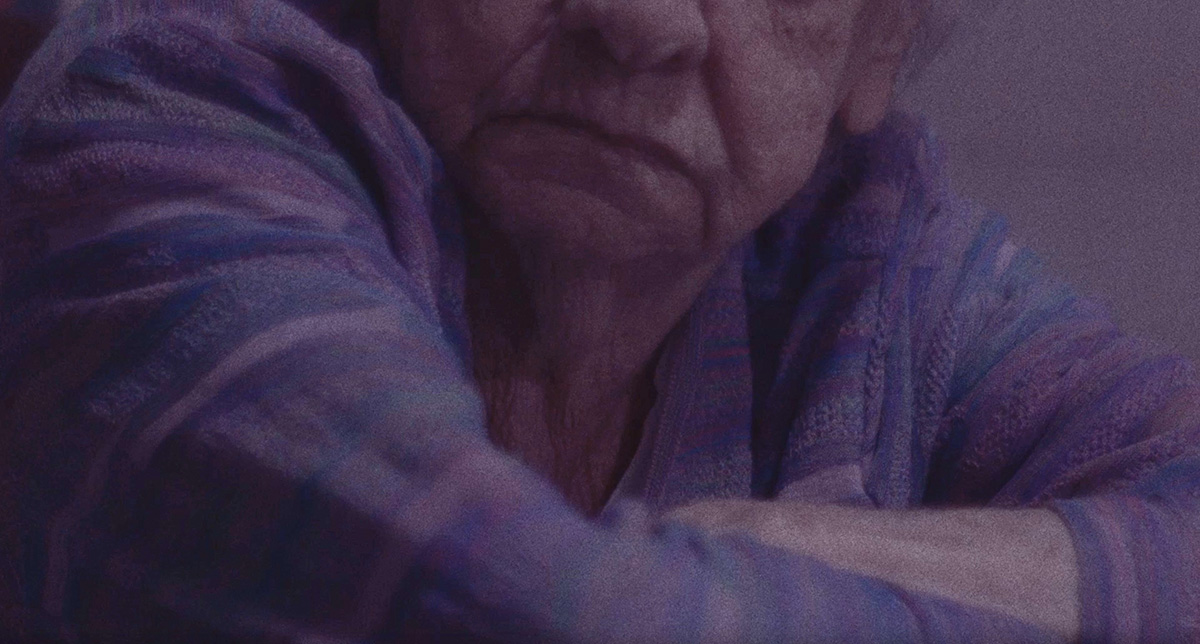
Les bruits de la respiration fatiguée et du funk brésilien. La bouche est la fenêtre de l'âme. À Xerém, une grand-mère de 97 ans n'a jamais été embrassée sur la bouche. Elle n'a jamais consenti à quoi que ce soit non plus, pour être honnête. Pendant ce temps, la jeunesse se promène dans les rues et les bois. Les mystères de l'amour et de la sexualité.
Née à Rio de Janeiro et élevée à Xerém, Ninah Nogino a obtenu son diplôme en Cinéma, pratique et esthétique, à l'Université Paris 1 Panthéon-Sorbonne. Après ses expériences scolaires, "Relato de Xerém" est son premier film.
Timothy Nohe
Catalogue : 2019Bell Labs Mosh | Vidéo expérimentale | mov | couleur | 5:12 | USA | 2018
Timothy Nohe
Bell Labs Mosh
Vidéo expérimentale | mov | couleur | 5:12 | USA | 2018
This data-moshing work was created while in residence at Signal Culture, Owego, NY. Part of a video series that examines the early information age, this industrial film was produced at Bell Labs and represents early experiments in rendering human speech and the "Poem Fields" computer animation work of Stan Vanderbeek and Kenneth Knowlton. Many of the inventions predicted within this video area a reality and commonplace, as accessible as our mobile phone. The original industrial film was made available under Creative Commons license, at archive.org
Timothy Nohe is an artist, composer and educator engaging traditional and electronic media in civic life and public places. His work has been focused upon sustainability and place, and musical and video works for dance and live performance. Nohe has exhibited and performed his work in a range of national and international venues: ISEA: Paris and the Baltic Sea; Ars Electronica, Linz; the Danish Institute of Electro-Acoustic Music, Århus; Museu da Imagem e do Som, São Paulo; the Centre for Contemporary Arts, Glasgow; the Irish Museum of Modern Art, Dublin, the Museum of Contemporary Art, Sydney; the Oxfringe Festival, Oxford; Fed Square, Melbourne; the Baltimore Museum of Art; the Smithsonian Institution, Washington, D.C.; The National Aquarium, Baltimore; Eastern State Penitentiary, Philadelphia; and the Museum of Jewish Heritage, New York. He was the recipient of a 2006 Fulbright Senior Scholar Award from the Australian – American Fulbright Commission, and was awarded the Commission’s 2011 Fulbright Alumni Initiative Grant, which resulted in multiple exhibitions in the United States and Australia on view from 2012 – 2016. Nohe has been the recipient of five Maryland State Arts Council Awards, and a Creative Baltimore Award. A 2011 National Endowment for the Arts and William G. Baker Fund “Our Town Project – Creative Placemaking†grant supported his My Station North: Sounds Surrounding Us through the Station North Arts and Entertainment District. A 2015 Warnock Foundation grant recognized Nohe’s work as a “Social Innovator†in modeling urban forest stewardship. He was commissioned as an exhibiting artist for Light City 2017, Baltimore; the festival attracted 470,000 visitors. In November of 2017 he debuted a solo exhibition titled Voltage is Signal: Analog Video Works by Timothy Nohe at the Kohl Gallery at Washington College, Chestertown, Maryland. That solo exhibition will be on view in the Electronic Gallery at Salisbury University, Salisbury, MD July 16 – October 25, 2018. Nohe is the founding Director of the Center for Innovation, Creativity and Research in the Arts (CIRCA) and a tenured Professor of Visual Arts at UMBC. A committed citizen of the university, he served two terms as the President of the UMBC Faculty Senate and in other key leadership positions. Nohe was an Artist in Residence at the Centre for Creative Arts at La Trobe University from 2011 – 2014. He was granted and renewed in the rank of Adjunct Professor at La Trobe University, in the Faculty of Humanities and Social Sciences, 2011 – 2015. He currently serves on the editorial board of the international journal, Unlikely, which is based in Melbourne, Australia. In fall of 2018 Nohe will be producing an immersive 360º video documentary on Baltimore’s failing sewage system and its interface with the watershed.
Barbara Noiret
Catalogue : 2007Verrière | Vidéo expérimentale | dv | couleur | 2:32 | France | 2006
Barbara Noiret
Verrière
Vidéo expérimentale | dv | couleur | 2:32 | France | 2006
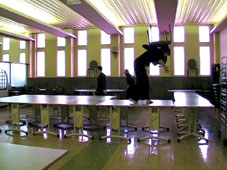
Cette vidéo résulte d?une performance réalisée pendant le déjeuner des patients et des soignants au restaurant de Institut Marcel Rivière, hôpital psychiatrique de la Verrière. Elle a été réalisée en collaboration avec Régis Bouchet-Merelli et Dominique Larcher, de la compagnie de danse contemporaine K-Denza. La performance a duré 25 min, seules 2?32?? ont été retenues pour créer cette vidéo, basée sur les mouvements des corps en lien avec l?architecture. La vidéo de cette performance est rythmée par le bruit ambiant du repas (assiettes, couverts, discussions?). Cette performance a été conçue en relation avec le contexte historique et architectural du restaurant : la salle dans laquelle se déroule la performance était réservée au repas des soignants dans les années 60. Cette pièce carrée est séparée par de grandes baies vitrées d?une autre salle de plus grande dimension, où déjeunaient les patients. A l?époque, ces baies vitrées servaient pour l?observation et le diagnostic des patients pendant le déjeuner. Aujourd?hui ces pratiques ne sont plus exercées, mais les soignants déjeunent dans cette même salle et les patients dans l?autre salle. La performance avait pour but que tous déjeunent dans le même espace, que l?espace à la fois ouvert et fermé par les verrières devienne un espace de performance, où les objets perdent leur fonction : Les tables sont assemblées - désassemblées, pour former un « plateau de danse », les chaises ne servent plus à s?assoire. Une tentative de perturber l?espace du repas, les habitudes de chacun, en créant une architecture mentale.
Je suis née en 1976, je vis et travaille à Paris. La galerie Frédéric Giroux représente mon travail depuis 2004. J?y ai réalisé une exposition personnelle en mai 2005 et la galerie m?a fait participer à plusieurs expositions collectives et foires d?art contemporain : Artissima, Turin ; FIAC 2004, 2005 et 2006 Paris. J?ai réalisée des projets d?exposition et de résidences dans deux centres d?art contemporain : Le Domaine départemental de Chamarande m?a invité en 2005 à réaliser un travail photographique et vidéo autour de la mémoire du château du domaine. Quelques oeuvres ont été montrées dans le cadre des journées du patrimoine, en septembre 2005 et seront exposées dans l? exposition « L?esprit des lieux » du 25 novembre 2006 au 5 février 2007. Le Domaine de Kerguéhennec, Bignan, m?a permis de présenté à l?issue de ma résidence de 3 mois un projet personnel, l?espace de l?image, dans les étages délaissés du château (en 2000). Le Fonds National d?art contemporain a fait l?acquisition de deux photographies réalisées au Domaine de Chamarande en 2006. J?ai déjà exposé en Allemagne, à Brême, à l?école d?art et de Musique (Hochschule für Künste Bremen). L?école m?avait conviée à participer à la présentation des ?uvres des étudiants de l?école, Hochschultage. J?y ai réalisée une installation vidéo in situ spécialement conçue pour l?occasion. Concernant d?autres interventions, L?Institut Marcel Rivière, hôpital psychiatrique situé à la Verrière (78), met actuellement à ma disposition un pavillon en friche depuis 2 ans. Mon projet consiste à travailler dans les différents espaces de l?hôpital et en relation avec les patients et soignants. Dans le cadre de ce projet, j?ai obtenu en 2005 l?aide individuelle à la création de la DRAC Ile-de-France et l?allocation d?installation (aide matérielle). J?ai effectué une courte résidence à La Casa de Vélasquez, Madrid, dans le cadre du projet de mise en scène Sin Escenario1 Identité et Image de David Ferré. Je suis intervenue en tant que scénariste photographe du projet (en 2001).
Catalogue : 2006C'est-à-dire | Art vidéo | dv | couleur | 4:30 | France | 2005
Barbara Noiret
C'est-à-dire
Art vidéo | dv | couleur | 4:30 | France | 2005
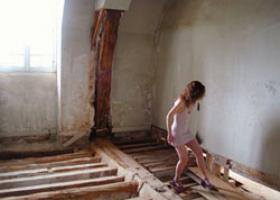
"Le temps de chaque séquence, il arrive quelque chose aux choses que représentent ces images pourtant presque fixes. Il arrive quelqu?un qui déplace, dérange ou modifie un point précis du cadre, pour faire un usage précis des lieux - exploration fastidieuse ou simple passer-par-là. Dans le cas précis de ces narrations minimales, la vidéo est une photographie qui dure longtemps." Eléonore Espargillière
Je suis née en 1976, je vis et travaille à Paris. La galerie Frédéric Giroux représente mon travail depuis l?exposition collective Le corps en perspective où elle m?avait invitée en 2004. La galerie m?a permis de faire une exposition personnelle en mai-juillet 2005 et m?a fait participer à plusieurs foires d?art contemporain : Artissima, Turin, Italie ; FIAC 2004 et 2005, Paris. J?ai réalisé des projets d?exposition et de résidences dans deux centres d?art contemporain : Le Domaine de Kerguéhennec, Bignan, où j?ai présenté à l?issue de ma résidence de 3 mois un projet personnel, l?espace de l?image, dans les étages délaissés du château (en 2000). Le Domaine départemental de Chamarande m?a invité cette année à réaliser un travail photographique et vidéo autour de la mémoire du château du domaine. Quelques travaux, notamment vidéos, ont été montrés dans le cadre des journées du patrimoine, en septembre 2005. Le Fonds National d?art contemporain vient de faire l?acquisition de deux photographies réalisées au Domaine de Chamarande. J?ai déjà exposé en Allemagne, à Brême, à l?école d?art et de Musique (Hochschule für Künste Bremen). L?école m?avait conviée à participer à la présentation des ?uvres des étudiants de l?école, Hochschultage. J?y ai réalisé une installation vidéo in situ spécialement conçue pour l?occasion. Concernant d?autres interventions, l?Institut Marcel Rivière, hôpital psychiatrique situé à la Verrière (78), met actuellement à ma disposition un pavillon en friche depuis 2 ans. Mon projet consiste à travailler dans les différents espaces de l?hôpital et en relation avec les patients et soignants. Dans le cadre de ce projet, je viens d?obtenir en 2005 l?aide individuelle à la création de la DRAC Ile-de-France. J?ai effectué une courte résidence à La Casa de Vélasquez, Madrid, dans le cadre du projet de mise en scène Sin Escenario1 Identité et Image de David Ferré. Je suis intervenue en tant que scénariste photographe du projet (en 2001). J?ai obtenue mon Diplôme National Supérieur d`Expression Plastique, avec les félicitations du Jury, à l?Ecole supérieure des Beaux-Arts d`Angers en 2000 et mon Diplôme National d?Art Plastique, avec mention, à l?Ecole supérieure des Beaux-Arts du Mans en 1998.
Simon Norfolk, Tate Films
Catalogue : 2013Burke + Norfolk: Photographs From The War In Afghanistan | Documentaire | hdv | couleur | 17:12 | Royaume-Uni | 2011
Simon Norfolk, Tate Films
Burke + Norfolk: Photographs From The War In Afghanistan
Documentaire | hdv | couleur | 17:12 | Royaume-Uni | 2011
In October 2010, Simon Norfolk began a series of new photographs in Afghanistan, which takes its cue from the work of nineteenth-century British photographer John Burke. Norfolk?s photographs reimagine or respond to Burke?s Afghan war scenes in the context of the contemporary conflict. Conceived as a collaborative project with Burke across time, this new body of work is presented alongside Burke?s original portfolios. The exhibition takes place in conjunction with an earlier complementary exhibition in March 2011 at the Queen?s Palace in the Baghe Babur garden in Kabul, supported by The World Collections Programme and the Aga Khan Trust for Culture, which resulted from a series of workshops with Afghan photographers, featuring work by Fardin Waezi and Burke alongside Norfolk?s own work.
Simon Norfolk was born in Lagos, Nigeria, in 1963 and educated in England, finishing at Oxford and Bristol Universities with a degree in philosophy and sociology. After leaving a documentary photography course in Newport, South Wales, Norfolk worked for far-left publications specializing in work on anti-racist activities and fascist groups, in particular the British National Party. In 1994 he gave up photojournalism in favor of landscape photography. His book For Most of It I Have No Words: Genocide, Landscape, Memory, about the places that have witnessed genocide, was published in 1998. The work was exhibited at many venues, including the Imperial War Museum in London, the Nederlands Foto Instituut, and the Holocaust Museum in Houston, Texas. Photographs of the war in Afghanistan in 2001, published as Afghanistan: Chronotopia, won the European Publishers` Award for Photography and an award from the Foreign Press Club of America and was nominated for the Citibank Prize. In 2004, Norfolk won the Infinity Award from the International Center of Photography in New York and in 2005 Le Prix Dialogue in Arles. His most recent book, Bleed, about the aftermath of war in Bosnia, was published in 2005. His work appears regularly in the New York Times Magazine and the Guardian Weekend.
Kristina Norman
Catalogue : 2023THIRST | Fiction expérimentale | 4k | couleur | 16:7 | Estonie | 2022
Kristina Norman
THIRST
Fiction expérimentale | 4k | couleur | 16:7 | Estonie | 2022
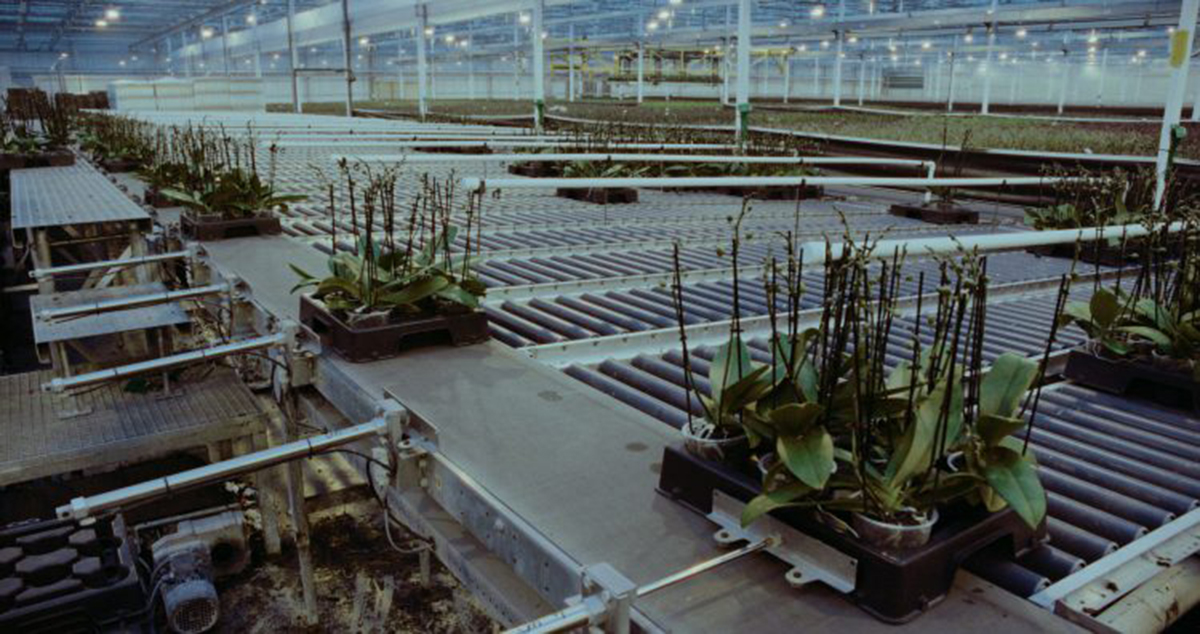
The film Thirst is a post-human choreography of machines and displaced plants. Millions of tons of Estonian peat end up in greenhouses in the Netherlands, where it is used as a soil substrate for tropical Phalaenopsis orchids. Meanwhile, local communities in Estonia are left with dry wells and a lack of drinking water as their fragile wetlands are drained for peat extraction. The orchids from the Netherlands then find their way back to supermarkets and homes in Estonia. It is a thirst for luxury and abundance that keeps the capitalist machinery running. Thirst is one episode from Kristina Norman’s Orchidelirium film trilogy. Commissioned for the Estonian Pavilion at the 59th International Art Exhibition – La Biennale di Venezia. Author and director: Kristina Norman Cinematographer: Erik Norkroos Composer: Märt-Matis Lill Choreographer and cast: Mari Mägi Produced by Rühm Pluss Null in collaboration with CCA Estonia
Kristina Norman (b.1979, lives and works in Tallinn) is an artist whose interdisciplinary work includes video installations, sculpture, and projects in the city space, as well as documentaries and performance. She is interested in the issues of collective memory, the memorial uses of the public space, but also the subtle sphere of the body politic that transgresses the boundaries between the public and the private. In 2009 she represented Estonia at the 53rd International Art Exhibition – La Biennale di Venezia, with a solo project; a multilayered mixed media installation entitled After-War. The project was a study of a conflict around the relocation of a Soviet monument in Tallinn. In 2022 at the 59th edition, the artist again represented Estonia with an ecocritical exhibition “Orchidelirium. An Appetite For Abundance”, a duo show with Bita Razavi, curated by Corina Apostol. Norman’s experimental film trilogy commissioned for the Estonian Pavilion, offers multiple ways to reflect on the legacies of colonialism from a specifically Eastern European perspective.
Kristina Norman, Muhu, Meelis
Catalogue : 2012ET MEELDIKS KOIGILE | Documentaire | betaSP | couleur | 87:0 | Estonie | 2011
Kristina Norman, Muhu, Meelis
ET MEELDIKS KOIGILE
Documentaire | betaSP | couleur | 87:0 | Estonie | 2011
In an atmosphere ripe with nationalism, two young engineers are commissioned by the Estonian Ministry of Defense to erect the country?s most important monument ? a statue commemorating the War of Independence. With strong political and social pressure, the heroes find themselves in many tragicomic situations and a constant row of ordeals. All of this paints a colorful and unique picture of the creation of a symbol during a time of financial crisis in Estonia.
Kristina Norman visual artist and documentary filmmaker born in 1979 in Tallinn, Estonia lives and works in Tallinn Education: 2010 Estonian Academy of Fine Arts, MA
François Nouguies
Catalogue : 2010Jean-Pascal pour la France | Fiction expérimentale | | couleur | 53:0 | France | 2009
François Nouguies
Jean-Pascal pour la France
Fiction expérimentale | | couleur | 53:0 | France | 2009
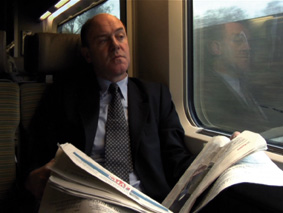
Jean-Pascal est un cadre supérieur actif dans sa société, impliqué dans son travail, soucieux de sa réussite professionnelle. Il est ce que l`on appelle un « rurbain » : vivant à la campagne, il effectue chaque jour de nombreux trajets en TGV pour se rendre sur son lieu de travail. Sa vie reculée à la campagne l`a amené, avec ces proches, à fonder un nouveau type de communauté, prônant le retour aux valeurs du terroir. Face aux problèmes que celle-ci doit surmonter, il entreprend de rencontrer de nouvelles personnes, elles-mêmes impliquées dans des réflexions sur la communauté.
François Nouguiès artiste et réalisateur vit et travaille à Paris - co-fondateur de Public> espace de diffusion de la création contemporaine www.onoci.com/public/infosgenerales.htm - représenté par la galerie Chez Valentin à Paris www.galeriechezvalentin.com - enseignant à l`école supérieur d`art de Grenoble depuis 2001 www.esag.fr/ François Nouguiès développe un travail vidéo lié à la performance et plus largement à l`organisation d`expériences, expériences sociales, recréant des contextes à caractère réactif. Tout d`abord présent sur la scène des Arts plastiques, il investit aujourd`hui davantage le champ cinématographique, notamment avec ses deux derniers films : « Le Dernier Film II », en 2004, et « Dancing Killing », en 2007, ainsi qu`avec son projet en cours : « Jean-Pascal pour la France ». À mi-chemin entre expériences et documentaires, le travail de François Nouguiès s`attache à faire apparaître les limites de certaines situations. PROJECTIONS 2007 « Prologue », autour de Fassbinder, http://conatus.series.free.fr/francais/saison1.html « Dancing Killing », Famu école de cinéma, Prague. Le Magasin, Centre National d`Art Contemporain, Grenoble. 2006 « Le Dernier Film II », l`atelier Galerie Nationale du Jeu de Paume, Paris. 2005 « Le Dernier Film II », Fémis, Paris. EXPOSITIONS PERSONNELLES 2004 « The Last Movie », Galerie chez Valentin, Paris. 2002 « Alex », Festival visu, Dieppe. Festival Nouvelles scène, Dijon. Festival de Belfort. Festival Tanze Um August, Berlin. 2001 « Alex », Festival Take Off, Théâtre de Châtillon. 2000 « SSA » Galerie chez Valentin, Paris. EXPOSITIONS COLLECTIVES 2007 « Territoires en expansion », Jeu de Paume hors les murs, Nogent-sur-Marne. 2006 « Re : re », Espace Paul Ricard, Paris. 2006 Galerie Dubellay, Rouen. 2005 Le magasin Hors Les Murs, Centre National d`Art Contemporain, Musée Dauphinois, Grenoble. 2004 « In/Ex-Hibition », Galerie Les Filles du Calvaire, Paris. 2004 « Double Trouble », La Galerie, FRAC, Montpellier. 2003 « Rencontres internationale de l?image », Ecole d?Art du Havre. 2002 « L?ami de mon amie », ENSBA, Cergy-Pontoise. 2001 « Bruit de Fond », Centre National de la Photographie, Paris. 2000 « TV Wonderland », Festival Belfort, France.
Waël Noureddine
Monica Nouwens
Catalogue : 2025This One Is For You Serra | Installation multimédia | digital | couleur | 17:54 | Pays-Bas, USA | 2023
Monica Nouwens
This One Is For You Serra
Installation multimédia | digital | couleur | 17:54 | Pays-Bas, USA | 2023
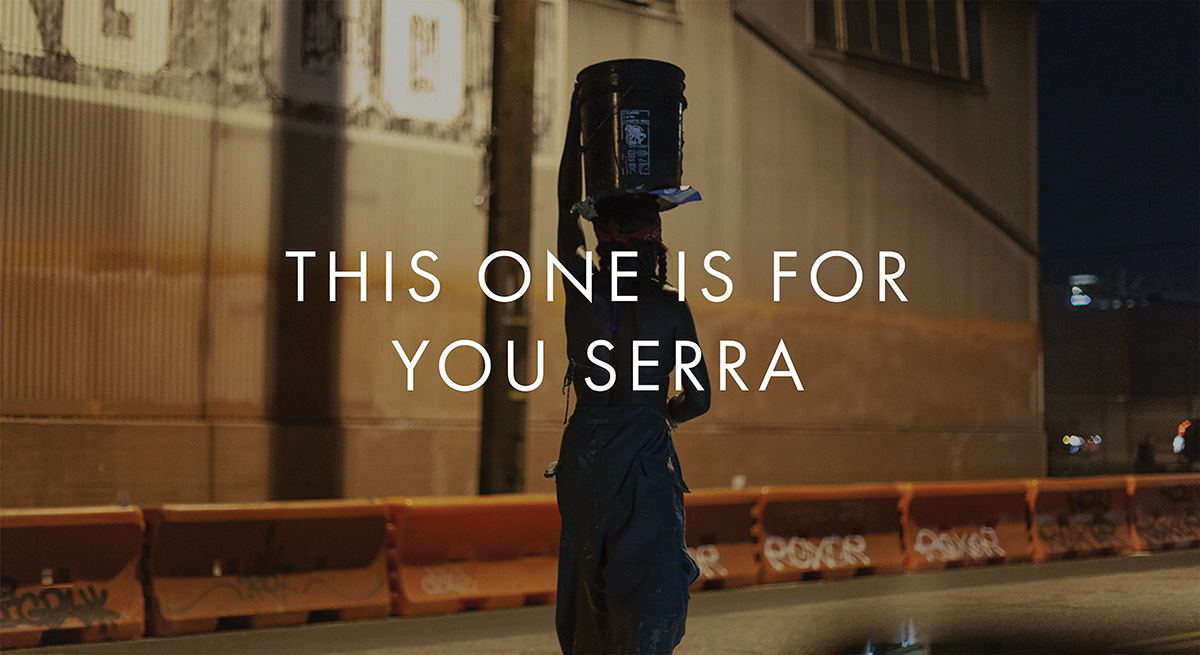
In Los Angeles, the city becomes electric when it gets dark. For artist Monica Nouwens, it's these hours after sunset when LA is most vibrant and alive in its diversity and spirit. Nouwens' body of work is comprised of her experiences after dark on the streets of South East LA and is, in many ways, a love letter to the City of Angels. Having first moved to Los Angeles in the '90s, Nouwens is has been noted for intimate and provocative portraits amidst continuously synthetic landscapes of decadence and decay. In her work, shot in a distinctly cinematic aesthetic reminiscent of old Hollywood noir, Nouwens captures the faces and scenes of those Los Angelinos who contribute to the cultural mosaic of the city.
Monica Nouwens is a fellow of the Rijksakademie van Beeldende Kunsten Amsterdam. She studied at the Willem de Kooning Academy and California Institute of the Arts. Nouwens exhibited at Netherlands Photography Museum Rotterdam, Photography Museum Amsterdam, Stedelijk Museum Bureau Amsterdam, The Wende Museum, and underground spaces. Nouwens first consideration are the people in the work, and so the work is shown first in the streets of Los Angeles. Her videos have been shown at the The rejected Film Festival. Nouwens teaches at the Departement of Cultural Affairs Los Angeles and taught at UCI, SCI-Arc, CalArts, University of Leiden, Universidad de Monterrey, Mexico and CCA, Montreal.
Kumjana Novakova
Catalogue : 2025Silence of Reason | Doc. expérimental | hdv | couleur | 63:0 | Macédoine, 0 | 2023
Kumjana Novakova
Silence of Reason
Doc. expérimental | hdv | couleur | 63:0 | Macédoine, 0 | 2023
Forensic video essay built as a performative research into the first international criminal tribunal case to enter convictions for rape as a form of torture and for sexual enslavement as crime against humanity. While working solely with visual archive and testimonies, The Silence of Reason acts as a memory itself: elusive, fluid, it rejects framing, moving in all directions, spatial and temporal. The singular experiences of violence and torture by women from the Fo?a rape camps during the war in Bosnia and Herzegovina become our collective memories, surpassing time and space.
Forensic video essay built as a performative research into the first international criminal tribunal case to enter convictions for rape as a form of torture and for sexual enslavement as crime against humanity. While working solely with visual archive and testimonies, The Silence of Reason acts as a memory itself: elusive, fluid, it rejects framing, moving in all directions, spatial and temporal. The singular experiences of violence and torture by women from the Fo?a rape camps during the war in Bosnia and Herzegovina become our collective memories, surpassing time and space.
Andrea Novoa
Catalogue : 2021Desastres Naturales | Film expérimental | 16mm | couleur et n&b | 26:39 | Chili | 2020
Andrea Novoa
Desastres Naturales
Film expérimental | 16mm | couleur et n&b | 26:39 | Chili | 2020
"Desastres Naturales" est la rencontre de trois films, trois territoires. Une récit personnel qui, à travers des expériences traduites en images et les extraits d'un journal, dessine le portrait de rencontres vécues et de lieux habités, traversés par des forces naturelles, des couleurs, des accidents et des luttes.
Andrea Novoa (née en 1988) est cinéaste. D’origine chilienne, elle réside dans la région de l’Araucanie, au sud du Chili. Le développement de son travail photographique analogique et de laboratoire débute au cours de ses études à l'école Foto Arte du Chili, Santiago (Chili). Elle obtient par la suite un master en Cinéma d'Essai de la EICTV - École Internationale de Cinéma et Télévision, San Antonio de los Baños (Cuba), où elle réalise ses premiers films. De 2017 à 2019, elle est membre du collectif de cinéma expérimental CEIS8, Santiago (Chili), qui organise des espaces de rencontres, de formations et de présentations liés au travail filmique. En 2019, son projet "Desatres Naturales" est sélectionné dans le cadre des résidences de post-production de l'Atelier 105 de Light Cone, Paris (France). Andrea Novoa co-dirige actuellement Praeclara Imagen, une maison de production et laboratoire cinématographique dans la région de l'Araucanie (Chili).
Dobroslawa Nowak
Catalogue : 2014I wszystko co ludzkie jest mi obce | Film expérimental | hdv | couleur | 14:39 | Pologne | 2013
Dobroslawa Nowak
I wszystko co ludzkie jest mi obce
Film expérimental | hdv | couleur | 14:39 | Pologne | 2013
"At first we could not believe it. We were terrified. ( ... ) Years we talked about Carly as if she wasn't there." Said Arthur Fleishmann about his autistic daughter, when a ten year old, for he first time in her life, made contact with the outside world, tapping on the keyboard "hurt" and "help". Her father's suprise resulted from the contact with her consciousness, which earlier didn't seem to him as a comparable to his. Visual basis of the work is passive video recording made by an animal. The theoretical - the concept of dissonance by social psychologist Leon Festinger. It's an unpleasant state of psychological tension that appears when at the same time there are two cognitive elements incompatible with each other. It leads to reformulation or addition of a new cognitive element. If the solution doesn't occur, unpleasant tension increases. Its value (force) is the greater the closer we are to the expected "point of relief." In the video work I realize perceptual dissonance between the remembered image - known to us, and the one being watched - experienced for the first time. The second one is strange, but elementary and first, which makes it close. The consequence of the transformation, which is conducted unconsciously by our 'self' is strengthening our ties with the object. Bill Viola wrote about one of his movies that watching them will 'penetrate the internal states and the connection with the animal consciousness that we all have'. An important product of the process described above is alleviation of bergson's intellect, which 'creates concepts to simplify certain entities so as to undergo quantification'. If the process of reformulation is successful, we have a chance to experience the intermediate borrowed intuition.
I graduated from University of Art in Poznań (2013). I study Psychology at University of Adam Mickiewicz in Poznań.