Catalogue > Search
Results for : Tout le catalogue

Francis Naranjo
EN UN PAIS LEJANO: UTOPOS
Video | | color | 4:50 | Spain | 2013
This is an experimental video work based on the premise of the introductory text: In a very far land, there exist some mythological creatures called SHICHAS. They combine the different gender alternatives and have the quality to absorb all negative energies keeping them inside. The whole piece has been built using a technique that links photograms together. It starts with a white screen where a set of black rectangles progressively spread on the surface of the image. Then, this image merges with another where some characters appear, who have their eyes covered with rectangles which hide their identities. This image represents the main hall of a geriatric, where we can see many residents whose memories are now defeated by their absence of identity. The work ends with a review of moments represented by souvenirs and the twist of those creatures that absorb the negative energy and stand for the globality, now sick and amnesic. The soundtrack is made with the sounds of corporal fluids.
FRANCIS NARANJO 1961, Santa María de Guía. Gran Canaria. España http://www.francisnaranjo.blogspot.com/ INDIVIDUAL PRESENTATIOS (SELECTION) 2014. Discordancias. Parque Cultural de Valparaíso. Chile. En un país lejano: utopos. Club Kitel Atacama. Bahía Inglesa. Copiapó. Chile. 2013. La paz armada. Centro de Arte Contemporáneo Wilfredo Lam. La Habana. Cuba. SAKER i LIVET . Galleri Lokomotiv. ÖKKV Kulturfabriken. Ömsköldsviks. Suecia. EUROPA (El continente triste). Centro Cultural de España. La Paz. Bolivia. 2012. La coleccionista de luces. Museo de Arte Contemporáneo. MAC. Santiago de Chile. Chile. White. Librería Fayad Jamís. XI Bienal de La Habana. Cuba. 2011. Personne n’est plus. Galería del Institut Français de Madrid. España. None is more. Instituto Cervantes de Rabat. Marruecos. ….agosto 2007…. Inauguración de Centro de Cultura Contemporánea San Martín. Cabildo de Gran Canaria. Las Palmas de Gran Canaria. España. Smile. Fundación Municipal de Cultura, Educación y Universidad Popular. Centro de Cultura Antiguo Instituto. Sala 1. Ayuntamiento de Gijón. España. GROUP PRESENTATIONS (SELECT) 2014. Cruces. Museo Nacional de Arte. La Paz. Bolivia. Festival de cine EL LUGAR SIN LÍMITES. Quito, Guayaquil, Manta, Cuenca. Ecuador. Cruce de colecciones (25 años del Centro Atlántico de Arte Moderno-CAAM).Centro Atlántico de Arte Moderno (CAAM). Las Palmas de Gran Canaria. España. Prohiviciones y Normatibas. Gabinete de Hygiene. Mercado de Tapineria. Valencia. España. 2013. SIART. Bienal de Arte Internacional de Bolivia. 8ª Versión. La Paz. Bolivia. V Semana de Vídeo Iberoamericano. Centro Cultural de España. La Paz. Bolivia. Cartografías de lo (im)posible. Centro de Arte Contemporáneo Wilfredo Lam. La Habana. Cuba. 12 fotos para 2013. S/t Espacio Cultural. Las Palmas de Gran Canaria. España. V Semana de Vídeo Iberoamericano. Filmoteca de Andalucía. Córdoba. España. 2012. Topographies virtuelles. Rencontres Internationales Paris/Berlin/Madrid. Palais de Tokyo. París. Francia. Reinventar la Isla 2. San Martín Centro de Cultura Contemporánea. Las Palmas de Gran Canaria. España. ALZHEIMER. Parque Cultural Ex Cárcel. Valparaíso. Chile. Identités. Recontres Internationales Paris/Berlin/Madrid. Haus der Kulturen der Welt. Berlín. Alemania. Olympic Fine Arts “OFA 2012”. Barbican Arts Centre. Londres. Reino Unido. Artistas de la Galería. Galería AFA. Santiago de Chile. Mulier-Mulieris. Museo de la Universidad de Alicante. Alicante. España. 11ª Bienal de la Habana. Prácticas artísticas e imaginarios sociales. La Habana. Cuba. A través del cristal. (Visiones fotográficas en la Colección del CAAM). Museo de Esculturas "Abraham Cárdenes". Tejeda. Gran Canaria. España. ArtBooks. Centro de Arte La Regenta. Las Palmas de Gran Canaria. España. 25 años de La Regenta. Centro de Arte La Regenta. Las Palmas de Gran Canaria. España. 2011. III Semana de vídeo Iberoamericano. Filmoteca de Andalucía. Córdoba. España. Revelaciones.Objetos, metáforas y ficciones en la colección del CAAM. CAAM - Sala San Antonio Abad. Centro Atlántico de Arte Moderno. Las Palmas de Gran Canaria. España. Identités. Recontres Internationales Paris/Berlin/Madrid. Centre Pompidou. París. Francia. Tesoros de los Museos del Cabildo de Gran Canaria. Colección del CAAM. Salón Noble del Edifici del Rellotge. Barcelona. España. Metamorphose. Recontres Internationales Paris/Berlin/Madrid. Auditórium del Ministerio de Cultura. Madrid. España. Creative Insomnia – Red night. Atelier Meta-morphic. Madrid. España. Longitudes de onda. Espacio de arte OTR. Madrid. España. Metamorphose. Recontres Internationales Paris/Berlin/Madrid. Haus der Kulturen der Welt. Berlín. Alemania.

Francis Naranjo
Iluminaciones urbanas 1
Art vidéo | dv | color | 4:28 | Spain | 2004
When Bird Songs are all that Abide Everything flows (?panta rehi?), as Heraclitus of Ephesus said some 2500 years ago. And Francis Naranjo, in his new video series, Iluminaciones urbanas (Urban illuminations), seems to be saying that we can?t see the same street twice, even when, as here, its his own street, because everything changes and nothing abides. The cars that animate the urban landscape aren?t the same cars; the sunlight which illuminates our everyday world varies in brightness and shines through distinct clouds; the neighbors we meet in the street look like mutants, they change clothes and moods, sometimes they greet us, at others they?re in a hurry?And us? How many ?I?s are there in ourselves? Moving images, like he world in Heraclitus? philosophy, seem to endlessly reprise themselves?being always different, the sound of bodily fluids accompany them, reinforcing the notion of bathing in a different river, though the river is always the same. Francis speaks of the continual internal and external flow, as though honing to the belief that there are some things which abide. But our biological fluids seem to always find a different path in the vascular labyrinth of our bodies, just as our human and automotive neighbors seem to create a city distinct from our own city with every passing day; just as we do from our own windows, and just as our neighbors do from theirs, always the same, always inert, always looking out on distinct scenes. In the past, it was thought that poor health came from the corruption or putrefaction of our bodily fluids. And bloody concoctions were created to eliminate them, to expel them from our body to flow toward the gutter. Through his videos Francis seems to puncture our idle everyday memory, drawing blood from our routine. But neither the blood flowing from our consciousness, nor we ourselves, would be the same?And maybe we have to repeat this conceptual bleeding forever in an eternal becoming, because everything flows? The Final Journey, by the Spanish poet Juan Ramón Jiménez (Nobel Prize, 1956) is one of the poems which best reflects this struggle/indecision/dichotomy between our ephemeral condition, our human desire for renewal, and our at times unavowed anxiety for permanence and transcendence: ?And I?ll depart. And the singing birds will abide; and my garden, with its green tree and white well, will abide. Every afternoon the sky will be calm and blue; And the church bells will ring in the belfry, Just like they?re ringing now. Those that loved me will pass away; and the village will renew itself each year; and in that whitewashed and florid corner of my garden my spirit will wander, nostalgic? And I?ll depart, and I?ll be alone, without a home, without my green tree, without the white well, without the calm, blue sky? But the singing birds will abide. And the videos of Francis Naranjo will remain to speak about becoming, about the guise of the false changes until the Final Change arrives.
1961, Santa María de Guía. Gran Canaria, España

Francis Naranjo
Los colores de la libertad: Blanco
Video | dv | color | 10:26 | Spain | 2010

Francis Naranjo
Return
Video | hdv | color | 8:12 | Spain | 2012
Return is the way back. The journey in the reverse direction. An alternative approach to the beginning. Then, from there, to recover the choice of starting " the new" trip. To get back lucidity from obsolescence.
Francis Naranjo is a Spanish artist born in Santa María de Guia, in the Canary Islands, in 1961. He has produced videos and installation pieces. His work develops problem areas pertaining to the society of information, highly technological, in which we are being controlled or in which we control, as well as globalization and the general use of new technologies. Among other places, his work has been exhibited in the in different cities of the world like Santiago de Chile, Berlín, New York, Göteborg, Miami, Uppsala, Madrid, París, Sevilla, Valencia, Casablanca, Tel Aviv, Montreal, South Korea, La Habana, etc.

Francis Naranjo
Smile
0 | dv | color | 1:10 | Spain | 2009
A voice in of us warns before the slogan that is repeated constantly: HELP, in which a character with their backs to appears right next to a loudspeaker, from where presumably comes the slogan; the character tour in a fused one giving the round and running against the camera, here a smile is generated that it closes the work.
Francis Naranjo is a Spanish artist born in Santa María de Guia, in the Canary Islands, in 1961. He has produced videos and installation pieces. His work develops problem areas pertaining to the society of information, highly technological, in which we are being controlled or in which we control, as well as globalization and the general use of new technologies. Among other places, his work has been exhibited in the in different cities of the world like Santiago de Chile, Berlín, Nueva York, Göteborg, Miami, Uppsala, Madrid, París, Sevilla, Valencia, Casablanca, Tel Aviv, Montreal, South Korea, etc.

Francis Naranjo
Viaje a Tiawanaku (Travel to Tiawanaku)
Video | hdv | color | 18:32 | Spain, Bolivia | 0
Viaje a Tiawanaku (Journey to Tiawanaku) is a tribute to Marisa Naranjo de la Coba, Francis Naranjo’s mother (who died in 2015 after a long illness), which becomes a tribute to all mothers. Marisa Naranjo never left the Canary Islands, she always travelled via other people’s memories. She led a remarkable life: her separation from her husband, whom she left while pregnant with her only child and amidst Franco’s dictatorship, meant she had to live with friends (in Santa María de Guía) because her circumstances prevented her from seeking the help of her family. A rural Spain immersed in poverty and a hypocritical morality meant that her son was her only concern. This video presents distinct journeys: a sensorial and initiatory one, where the soundtrack, images and poetry merge to help us on this passage which the human condition guides us on through its emotions; and another, physical and tangible. Following her death, Marisa embarks on her last voyage to experience of Tiawanaku (Bolivia). This time, it’s her ashes which travel, to resume the journey by way of our memory, where she awaits us to continue with the cycle of life.
Francis Naranjo is a Spanish artist born in Santa MarÃa de Guia, in the Canary Islands, in 1961. He has produced videos and installation pieces. His work develops problem areas pertaining to the society of information, highly technological, in which we are being controlled or in which we control, as well as globalization and the general use of new technologies and the human condition. Among other places, his work has been exhibited in the in different cities of the world like Santiago de Chile, BerlÃn, Nueva York, Göteborg, Miami, Uppsala, Madrid, ParÃs, Sevilla, Valencia, Casablanca, Tel Aviv, Montreal, South Korea, La Paz, Quito, Buenos Aires, Londres, Uppsala, etc.
Francis Naranjo
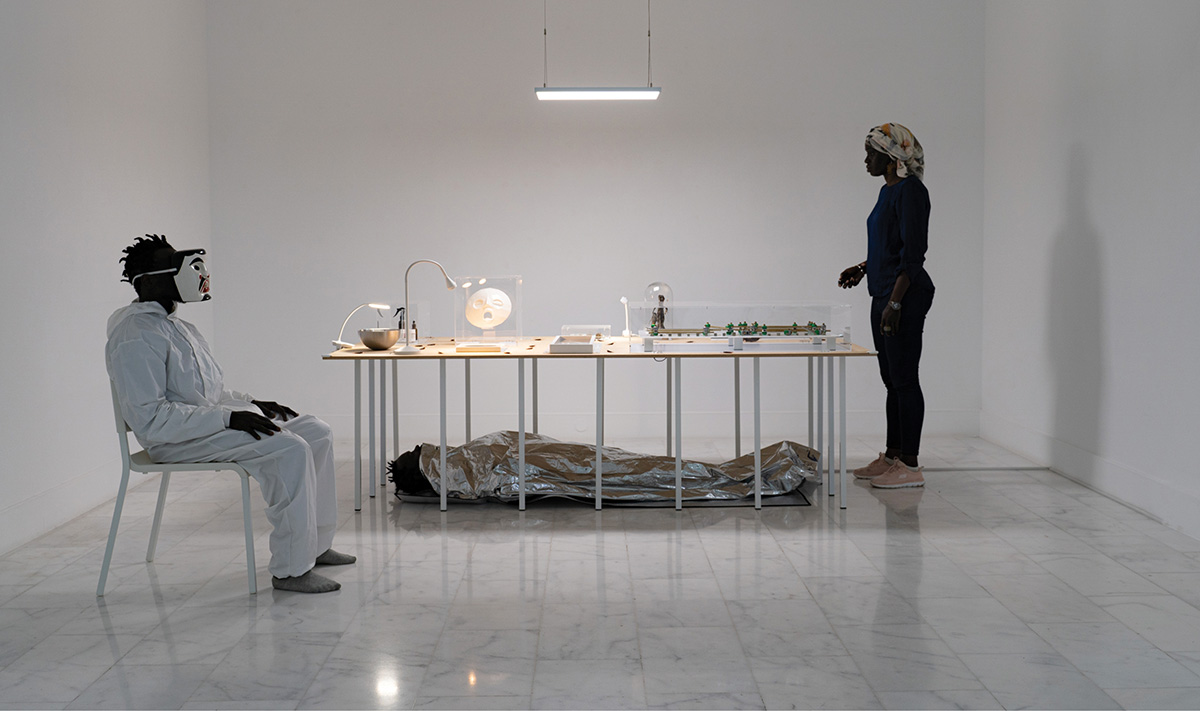
LA POSIBILIDAD DE LA MÁSCARA BLANCA
Video | 4k | | 3:53 | Spain | 2022
The possibility of the white mask is presented as a discussion table that houses its own jail. Above it is a composition of elements that reflect on the indigenous, on the "others", on the human condition, on contamination, extractivism, memory, migrations, and above all, putting on the table the fracture that separates us. In this proposal we use two masks: One from the African continent: Ghana; and another from the South American continent: Bolivia. Both refer us to ancestral thoughts. Migrations and rites relate them in their intentions. The Ghanaian Ashanti tribe mask (present on the table) are often part of ceremonial attire and worn at religious and social events to represent the spirits of the ancestors. In the mask of the Grandparents (Bolivia, Chiquitanía) tradition indicates that it was a form of mockery that the elders of San José used with the young Chiquitanos, who followed the teachings of the recently arrived Jesuit missionaries. It was the way they tried to dissuade them from embracing the new customs and religion. The possibility of the white mask is presented to us as a ritual where the fractures on which to reflect are different.
Francis Naranjo. Born in Santa María de Guía (Gran Canaria, Spain), in 1961. Multidisciplinary artist who crosses artistic limits exploring in constant research and experimentation, which focuses his process on the investigation of the relationships between the human condition and factors of the prevailing system. He has carried out public works, he has lectured, he has curated, he has written about artists and reflections, he has carried out and participated in numerous individual and collective exhibitions, among other activities. In recent years his activity is focused, above all, in South America.
Aily Nash
Omiya Hachiman Dori
Experimental doc. | hdv | color | 33:38 | USA, Japan | 2013
The small shops in the typical Tokyo neighborhood of Omiya line Omiya Hachiman dori, the main street which leads to a 9th century Shinto shrine. From tofu makers, dry cleaners, hairdressers, to tatami-mat makers, the intimate portraits of these shops and their owners meditate on quotidian tasks, and the environment in which they?re performed.
Aily Nash (b. 1984 in Tokyo, Japan) is a curator, writer, and filmmaker. She received her BA from Bard College where she studied Film and Electronic Arts, and Literature. Her curated programs have screened in venues including MoMA PS1 (NYC), FACT (Liverpool), BAM/Brooklyn Academy of Music (NYC), Anthology Film Archives (NYC), in Light Cone`s Scratch Expanded (Paris), Northwest Film Center (Portland), Image Forum (Tokyo), Echo Park Film Center (L.A.), Art Cinema OFFoff (Ghent), and others. Her writing has appeared in the Brooklyn Rail, Artforum.com, Film Comment, Kaleidoscope, de Filmkrant and elsewhere. She curates films at Basilica Hudson, and is an editor of a film criticism program at the Berlinale. She is based in Hudson and Brooklyn, NY.

Arash Nassiri
City of Tales
Experimental film | 4k | color | 21:30 | France | 2017
SYNOPSIS COURT : At night, during the Persian new year celebrations in Spring, the inhabitants of Los Angeles become the hosts to memories of Tehran. They no longer speak English, but a Persian idiom. Neon lights fill the streets with psychedelic colors. During this interval, like the old roman technics of the memory palace which used space visualisation to memorize information, the material space of the ephemeral and mutant territory of Los Angeles streets are used to host the memory of Tehran one last time before disappearing. SYNOPSIS LONG : At night, during the Persian new year celebrations in Spring, the inhabitants of Los Angeles become the hosts to memories of Tehran. They no longer speak English, but a Persian idiom. Neon lights fill the streets with psychedelic colors. During this interval, like the old roman technics of the memory palace which used space visualisation to memorize information, the material space of the ephemeral and mutant territory of Los Angeles streets are used to host the memory of Tehran one last time before disappearing. To write this film Arash Nassiri interviewed a group of Iranians around Europe and North America that used to live in Tehran in the seventies. At this period, the Iranian city was heavily influenced by western culture. Architects from California and Los Angeles where commissioned to build the urban planning of Tehran. The sociologist used to describe this phenomenon as Tehran-Los Angeles. This fantasy of western modernity ended abruptly at the revolution, thus never fully realized and now living only in the memory of people who lived in Tehran during this era.Â
Arash Nassiri is a young Franco-Iranian artist born in Teheran in 1986. He lives and works in Paris. After a time at the Beaux-Arts in Paris, an exchange in Berlin to study the relationship between art and technology, and a career at Arts-Décoratifs in Paris to study photography and video, he finished his studies at the prestigious Fresnoy in Tourcoing. Arash Nassiri uses places as the frameworks to produce his work in, as in Land Art. These places can be very specific, like a ruined building, or a whole city, as in the video Tehran-geles where Los Angeles is used as the representation of Tehran. The work produces a discussion between two opposite poles: the materiality and the virtuality of the place «I like to imagine my projects as Embassies. They are representations of speculative spaces, where our ideologies can become visible and malleable». His films have been shown in many exhibitions and festivals in France and abroad such as the Triennale of Istanbul (2010), the Venice Architecture Biennial, the Biennale de Lyon as part of the Palais de Tokyo group exhibition Le Parfait Flâneur (2015), Fundacio Sunnol, Barcelona (2016), the Shanghai Himalaya Museum (2016) and the Berlinale (2018). Arash Nassiri is the winner of the Press Award, Les Enfants Terribles, Huy, Belgium (2014); the Best Experimental Short Film Award, festival Côté-Court Pantin, Paris (2014); and the RMIT University Award for Best Experimental Short Film, Melbourne Int. Film Festival, Australia (2015).

Arash Nassiri
Tehran-Geles
| | color | 18:10 | Iran | 2014
Tehran-Geles is a fictional vision of Tehran, set within the urban landscape of Los Angeles. Through an aerial journey, we discover an architectural transposition of the two cities. While flying over the LA boulevards, personal migrant testimonies echo the collective story of the Iranian capital. Downtown, the buildings are saturated with neon signs pulsating with voices that take us on a hallucinatory trip. Parallel to the science fictional genre – where the present is projected into the future – this short film projects the past of Tehran into the Western present. The production of this short film generated an audio-visual `migration`, where aerial shots of Los-Angeles merge with videos filmed in Tehran and later transported by plane, as well as interviews recorded via Skype in different cities around the world.
Born in 1986 in Tehran, Iran, Arash Nassiri works and lives in Paris, France. Arash graduated from the Ecole Nationale Supérieure des Arts-Décoratifs in 2012. He is also a 2014 graduate of Le Fresnoy, National Studio of Contemporary Arts . Arash’s academic achievements include courses at the Paris National School of Fine Arts (Ecole Nationale Supérieure des Beaux-Arts de Paris) in 2007, and at the University of the Arts in Berlin, where he lived in 2010. Arash has showcased his work in exhibitions, both in France and abroad, including the 2011 Galerie du Crous, the 2013 and 2014 Panorama exhibitions, the Venice Biennale of Architecture, and the "From the object to the city" exhibition organized by the National School of Arts in 2010. In July 2014, his work was featured in cultural magazine, Les Inrockuptibles. Arash has also been awarded the 2014 Cote Court Pantin Grand Prize for Video Art and the Les Amis du Fresnoy Prize. His video Tehran-Geles will be featured in the international film festival of Bucharest in Romania next Decembre.

Frederic Nauczyciel
Red Shoes
Video installation | hdv | color | 4:17 | France | 2015
Red Shoes est un rituel. Le vogueur Kendall Mugler (Paris) mets ses talons aiguille rouges, et remplit l’espace d’une énergie dite « dramatique » - c’est à dire : théâtrale, sauvage, hautement technique, audacieuse.
Frédéric Nauczyciel est un artiste visuel français. Il travaille entre la France et les Etats-Unis. Nourri par la danse et le cinéma, il réalise des photographies, des films et des performances. Il construit avec ses sujets des images collaboratives qui tendent vers une hybridation des formes. Il fait appel à l’expérience de la performance pour produire des « images vivantes » qui convient la présence. Depuis 2011, il déploie son travail entre les ghettos noirs de Baltimore et la périphérie parisienne, puisant dans la force des langages performatifs tel que le voguing. Il expose en France (Musée de la Chasse à Paris, Mac/Val, Eté Photographique de Lectoure, Rencontres Internationales de Photographie d’Arles, Festival d’Avignon, Centre Pompidou Paris), à Barcelone (Palau de la Virreina), ou aux Etats-Unis (Washington, Houston, Baltimore et New York). Il est lauréat en 2011 de la Villa Médicis Programme Hors les Murs pour les Etats-Unis (Institut Français), reçoit en 2013 l’Allocation de recherche du Centre National des Arts Plastiques et figure dans la collection du Fonds national d’Art Contemporain (Public # Ceux qui nous regardent, Le temps devant et The Fire Flies, Baltimore). Il est en résidence en Seine-Saint-Denis pour deux années, de 2014 à 2016.

Frederic Nauczyciel
THE FIRE FLIES, FRANCESCA, BALTIMORE
Experimental doc. | hdv | color | 39:35 | France, USA | 2014
The Fire Flies, Francesca, Baltimore est une fable urbaine, un ‘road movie’ à la recherche d’Omar, personnage culte de la série TV « The Wire [Sur Ecoute] ». L’installation met en tension une traversée de Baltimore en voiture et une plongée dans la communauté des vogueurs de la ville – performers homosexuels et transgenres des ghettos noirs de la ville – avec des intrusions sophistiquées de Francesca à New York. Le film joue comme une porte dérobée qui invite à pénétrer un monde caché. L’éclatement du montage, en une succession et une superposition de séquences quasi brutes réalisées avec un iPhone, met la vision en défaut et rend compte de manière volontairement lacunaire d’une réalité qui ne peut se livrer complètement. La fragmentation du montage nous invite à éprouver plutôt que comprendre ce langage du corps sophistiqué et performatif. La boucle propose une progression, de documents bruts à des séquences plus formelles, des sons des balls à la musique baroque de Bach, avec des passages au blanc aveuglants et sonores qui rappellent la piste d’un ballroom. Ce n`est pas un documentaire sur le voguing, mais le making off d`un travail de création avec les vogueurs de Baltimore dans le décor et la réalité de cette Ville. La scène d`exposition, long plan séquence sur un parking, présente les personnages qui jalonnent cette traversée, pour raconter la rencontre improbable entre les vogueurs, Francesca et Omar.
Frédéric Nauczyciel est un artiste visuel français. Il travaille entre la France et les Etats-Unis. Nourri par la danse et le cinéma, il réalise des photographies, des films et des performances. Il construit avec ses sujets des images collaboratives qui tendent vers une hybridation des formes. Il fait appel à l’expérience de la performance pour produire des « images vivantes » qui convient la présence. Depuis 2011, il déploie son travail entre les ghettos noirs de Baltimore et la périphérie parisienne, puisant dans la force des langages performatifs tel que le voguing. Il expose en France (Musée de la Chasse à Paris, Mac/Val, Eté Photographique de Lectoure, Rencontres Internationales de Photographie d’Arles, Festival d’Avignon, Centre Pompidou Paris), à Barcelone (Palau de la Virreina), ou aux Etats-Unis (Washington, Houston, Baltimore et New York). Il est lauréat en 2011 de la Villa Médicis Programme Hors les Murs pour les Etats-Unis (Institut Français), reçoit en 2013 l’Allocation de recherche du Centre National des Arts Plastiques et figure dans la collection du Fonds national d’Art Contemporain (Public # Ceux qui nous regardent, Le temps devant et The Fire Flies, Baltimore). Il est en résidence en Seine-Saint-Denis pour deux années, de 2014 à 2016.

Frederic Nauczyciel
The Fire Flies, Francesca, Baltimore
Video | hdv | color | 1:6 | France, USA | 2012
"The Fire Flies, Francesca, Baltimore" Frédéric Nauczyciel, 2011/2012 "The Fire Flies, Francesca, Baltimore" est un road movie, une fable urbaine, une traversée de Baltimore en voiture le long de North Avenue, et une plongée dans la culture underground homosexuelle et transgenre des ghettos noirs de la ville. The Fire Flies, ce sont des lucioles, la flamboyance des Voguers de Baltimore qui se performent la nuit dans des Balls. En me rendant à Baltimore, j`allais sur les traces d?Omar, le personnage culte de la série "The Wire" qui a popularisé la Banjee Realness, cette posture de fierté des hommes homosexuels des ghettos en résistance à la culture dominante, une forme de dissimulation choisie destinée à déjouer les attentes. Je ne pensais pas m`intéresser au Voguing, cette danse performative née dans les ghettos noirs puis latinos de Harlem dans le New York des années 60 : une succession virtuose des poses des mannequins en couverture du magazine Vogue. La rencontre avec les Voguers s`est imposée, parce qu`ils sont tous Omar, selon le moment ou la situation. "The Fire Flies..." n`est pas un documentaire sur le voguing, donc, mais le making off d`un travail avec des voguers, tiré de leur réalité à Baltimore. "The Fire Flies, Francesca, Baltimore" est l`adaptation d`une installation vidéo multi-écran, présentée au Mac/Val*. Sur le mur extérieur d`une boîte, défile une traversée de North Avenue, qui sépare la ville en deux. A l`intérieur, des séquences quasi-brutes, sans sous-titres, se déploient sur trois murs. Le son des deux films se mélangent, envahit l`espace de la boîte pour créer un cinquième mur imaginaire. "The Fire Flies, Francesca, Baltimore" met en tension une traversée de Baltimore en apparence monotone et une plongée dans des abysses qui affleurent peu en surface, avec des intrusions sophistiquées de Francesca à New York. Le film joue comme une porte dérobée qui invite à pénétrer un monde parallèle. Se déploient des séquences en format vertical ou horizontal, rythmées par la musique et les sons, avec des temps morts, des accélérations, des plans séquences plus longs, des ruptures au noir - ou au blanc éblouissant - pour laisser des ambiances sonores ouvrir sur l?imaginaire de la ville. L?éclatement du montage rend compte de manière volontairement lacunaire d?une réalité qui ne peut se livrer complètement et met la vision en défaut. Il invite à appréhender ce langage des corps très codifié, à l?éprouver plutôt qu?à le comprendre. Le film propose une progression des documents bruts vers des séquences plus formelles, des sons scandés des Balls où les voguers performent et se défient, à la musique baroque de Bach et une danse improvisée - documentant ainsi le processus du travail de création lui-même. Dans dans sa version finale pour un écran, le film conserve son aspect expérimental avec une superposition des films mettant en regard la ville et les voguers. La scène d`exposition, calée au milieu du film, long plan séquence sur un parking, montre les personnages qui jalonne le périple, installe une narration reposant sur la rencontre improbable entre les Voguers, Francesca et Omar. Une traversée de la sensualité des faubourgs, une poétique de la survie. Durée : 56` * Mac/Val, musée d`art contemporain du Val de Marne à Vitry (Grand Paris), du 29 juin au 16 septembre 2012 dans le cadre de l?exposition temporaire "Situation(s)" (commissaire : Frank Lamy)
Frédéric Nauczyciel est né en 1968 à Paris et travaille à Paris et aux États-Unis. Il est diplômé d`un Magistère de Finance et d`un DEUG de Japonais. Administrateur de danse contemporaine, il découvre la force de la photographie par l`usage d`un Polaroïd. Il en fait sa pratique après avoir vu l`exposition Anthropologie Involontaire à l`Hôtel de Sully et la rétrospective Philip-Lorca diCorcia au Centre national de la Photographie en 2003. Sa démarche est nourrie par la photographie américaine et la danse (héritées de sa collaboration avec le chorégraphe Andy DeGroat), la peinture, ainsi que le cinéma qui a nourri son adolescence en lointaine banlieue. En réalisant une image rejouée dans l`instant dans un café de Little Italy à New York en 2004, il renoue avec l`expérience partagée du Polaroid tout en intervenant dans la mise en scène et le travail de la lumière. Les scènes et portraits construits avec ses sujets sont mis en partage pour produire des images qui dépassent la seule identité, un va-et-vient entre biographie, document et fiction, pour dégager une part intime du réel. Ses travaux personnels lui ont valu les commandes de la Ville de Paris, du Centre Pompidou (Paris et Metz, département Jeune Public), du Festival d`Avignon, de la Ville de Pantin, du Théâtre National de Chaillot? et de la presse ; ainsi que des collaborations artistiques avec la circassienne Satchie Noro, la chorégraphe Germana Civera, le Centre Dramatique National d?Orléans (direction Arthur Nauzyciel), l?École Régionale d`Art de Besançon. En 2007/2008, il est lauréat d`une Carte Jeune Génération Culturesfrance (Institut Français) et d`une résidence à l`Institut français de Barcelone pour Demeure Intime, reconstructions de l?intime familial (Stockholm, Paris, Barcelone). En 2008, il expose au festival d?Avignon trois tirages monumentaux du Public assis dans les gradins de la cour d?Honneur; des photographies plein cadre réalisées avec un temps de pause égal à la durée de la représentation. La carte blanche donne lieu en 2009 à une résidence à l?Ecole Régionale d?Art de Besançon et au Centre de Photographie d?Ile de France pour l?exposition Ceux qui nous regardent. En 2010, à la demande du Centre d?Art et de Photographie de Lectoure, il réalise un ensemble fini de 9 portraits, Le Temps Devant, une série d?images fortement mises en scène et d?inspiration picturale qui évoquent l?utopie rurale, le rapport au temps qui passe et l?anachronisme. Il fait son entrée dans la collection du Fonds National d?Art Contemporain. The Fire Flies (Baltimore), ensemble de photographies, de films et de performances, projet pour lequel il est lauréat du Programme Hors les Murs ? Institut Français pour les Etats-Unis (Baltimore) en 2011, interrogent la dissimulation et les représentations du corps masculin en milieu hostile. The Fire Flies, Francesca, Baltimore, installation vidéo pour 4 murs, est, après une première version pour la Nuit Blanche, présentée au Mac/Val (Vitry, grand Paris). Ce projet, mené avec des Voguers de Baltimore, performeurs homosexuels et trans genres des ghettos noirs de la ville, l?amène à ouvrir sa pratique photographique à tout ce qui pourrait rendre compte de l`expérience et mettre en jeu le corps, de la vidéo à la danse. Il collabore régulièrement avec l`anthropologue Eric Chauvier, l`écrivaine Anne Brunswic, la sociologue Nacira Guénif ainsi qu?avec les performeurs Elise Ladoué, Aragorn Boulanger, Francesca et les Voguers de Baltimore, New York et Paris.

Frederic Nauczyciel
La Peau Vive [Skin Live]
Video installation | hdv | color | 38:0 | France | 2017
J’ai invité dans le studio des complices de plusieurs années, issus de la communauté noire transgenre des deux territoires, et d’autres artistes connus ou inconnus, engagés dans des pratiques performatives, masculines et féminines, urbaines et savantes, waaking, krump, art performance, slam... Tous sont reliés par un désir puissant d’inventer leur identité et par une appartenance revendiquée aux marges, réelles et symboliques. Je leur ai proposé de filmer eux-mêmes leurs tatouages, leurs scarifications, leur peau, face à la caméra ; et ce faisant, à échantillonner, une partie de leur histoire.
Frédéric Nauczyciel est artiste visuel. Il vit à Paris et travaille entre Paris et Baltimore. Depuis 2011, il déploie des installations vidéos, des photographies et des performances qui relient les ghettos noirs de Baltimore et la périphérie parisienne, puisant dans la force de langages performatifs tel que le Voguing, les fanfares déambulatoires ou la langue des signes. Ses projets en cours sont des récits mettant en jeu la langue, la trans-communauté, la traversée des lignes de partage. Il développe l’idée d’un “ endroit de confiance “, un espace libre d’assignation où la singularité de chacun existe sans labellisation. Il a exposé au Musée de la Chasse à Paris (2012), au Mac/Val (2012), au Festival d’Avignon (2013), au Palau de la Virreina, Barcelone (2010), au FotoFest International, Houston (2015) entre autres. Ses films ont été montrés aux Rencontres Internationales Paris / Berlin, au Festival Distrital à Mexico City, au Palace Festival à Chicago, etc.

Armando Navarro
Teenage God
Multimedia performance | 0 | | 30:0 | France | 1998
Cette performance musicale est une expérience immersive qui prend la forme d’une série de rituels, que les spectateurs sont invités à accomplir pour faire partie de la secte pop: †eenage god. †eenage god est un projet collectif, multimédia et transdisciplinaire, qui combine les formes d’art et génère aussi des formes qui peuvent exister indépendamment des performances: musique, vidéo, photographie, livre, installation, livestream, etc. Dans cette satire de l'obsession pour les stars et les dieux, fans et secte se reflètent mutuellement comme dans des miroirs déformants. L’adoration de Britney Spears et de Shoko Asahara, la vénération de One Direction et de Heaven’s Gate, rituels pop et cérémonies mystiques s’entrechoquent et fusionnent pour tendre "un miroir de mort" à la société de consommation, comme dans "Scorpio Rising".
Armando Navarro est né à San Francisco (USA), et vit à Paris (France). Il est à la fois américain et français. Sa curiosité l'a poussé sur de multiples chemins à la croisée des arts plastiques et du cinéma: lettrisme, art contemporain, cinéma expérimental, art vidéo, clips, expositions, installations, performances, laboratoire cinématographique partagé, 1er rôle d'un long métrage et même une émission de radio. Son passage dans de grandes agences de publicité lui a permis d’observer d’un peu plus près les obsessions sociales dont il fait la satire dans "†eenage god" et "Size Zero".

Mario Navarro
The Dreams of Sttaford Beer
Art vidéo | dv | color | 7:48 | Chile | 2007
In 1971, an innovative system of information management and transfer began developing in Chile during the government of President Salvador Allende; the CYBERSYN project, cybernetic synergy or SYNCO, information and control system. In Chilean State owned companies a system for capturing, processing and presenting economic information to be managed in ?quasi? real time, becoming an absolute pioneer in the application of a cybernetic model in mass socio-economic contexts, and based on a convergence of science, technology, politics and cybernetics. In 1972 was constructed a ?futuristic? CONTROL ROOM for to manage information an data. The scientific director of the project was the Britain?s Stafford Beer, father of global cybernetics, In this fictional mise en scène, Stafford Beer imagines in dreams -in a hotel room- how to construct and to implement its project in Chile, but all the time blurredly and apparently drunk, Beer very insistently tries to show a coherent structure of interaction, that nevertheless is not perfect nor correct for anybody more than he.
Mario Navarro (1970), Live and work in Santiago, Chile. He studied visual arts in the Universidad Católica de Chile. Has been invited, as an artist in residence, to Couvent des Récollets, Paris (2003) and recently has been invited to IASPIS, Stockholm. Mario Navarro has participated in numerous international exhibitions, such as Santiago Manifest?, Centro Cultural Matucana100, Santiago (2007), ?Sur Scene?, Chateau de Tours, France (2007), ?XXVII Bienal de São Paulo?, (2006), ?IV Liverpool Biennial ?(2006), ?Busan Biennial?,Korea (2006), ?Efecto Downey?, Espacio Telefónica, Buenos Aires, Argentina (2006). As solo shows it is important to mention: ?Red Diamond?, Salvador Allende Museum, Santiago, (2007), ?Not Like this, like this?, Lakeside Kunstraum, Klagenfurt, Austria (2006), ?Dignidad?, Die Ecke Gallery, Santiago, (2005), ?30 days with nothing?, Public intervention Canal Saint Martin, Paris (2003) As a curator has created the projects ?Daniel Lopez Show?, Withe Box and Roebling Hall, New York (2007), ?Transformer?, Centro Cultural Matucana 100, Santiago (2005) and ?Doméstico?, MAC, Valdivia, Chile (1999)

Armando Navarro
†een?ge g?d
Multimedia performance | 0 | | 45:0 | France | 2022
Immersive, participatory rituals that the audience performs to become part of the pop cult: †een?ge g?d.
†een?ge g?d is a multimedia and interdisciplinary collective that explores the limits between religion, pop culture and art, spectator, performer and creator, stage and auditorium, high, low and non-art... This project combines mediums and also generates forms that can exist independently from the performances: teen thriller, music, DJ set, dance, video, photography, performative sculpture, book, installation, livestream, teen workshop...

Maia Navas
Enviado para falsear
Experimental doc. | mov | color | 6:4 | Argentina | 2021
Someone shot down with a slingshot a Chaco police drone in the Gran Toba neighborhood in Resistencia (Chaco, Argentina) during June 2020; the Qom indigenous community was being militarily monitored with the argument of controlling the spread of covid-19. One hundred years ago, before bombing the Qom people in the Napalpí massacre, a group of people of the air force posed for a photo that years later would be used as evidence against the State in the judgment against humanity. The arrangement of closeness between the images of dissimilar times accentuates the similarity between their operating mechanisms in distant times and with different technologies. Faced with the microfascisms of today and always in the same territory, the slingshot is perhaps a decolonial gesture of resistance against systematic violence and the despotism of images.
Filmmaker, researcher and curator. Her works have been exhibited in different festivals in Latin America, Europe and Asia. Among them, DocLisboa, Jeounju International Film Festival, BAFICI, Bienal de la Imagen en Movimiento, Frontera Sur. Her filmography includes Procedimientos (2014), Sueño (2015), Enviado para falsear (2021). She received awards and mentions at the VideoBabel Festival, Fondo Nacional de las Artes, Plataforma Futuro, Gestionar Futuro, Lapacho Festival, Premio Cine.ar, Festifreak Festival, 10cortos10, Bienal de la Imagen en Movimiento. She worked in video and film curatorships for Barim (South Korea), Festival International Proyector (Madrid), Centro de Arte Sonoro (Bs. As). She teaches at Universidad Nacional del Nordeste. She studied Bachelor of Arts and Technology; Master in Aesthetics Latin American contemporaries. She is the author of various essay articles in around cinematographic and videographic works; compiler and author of the book Ensayar lo imposible. For 12 years, she has been directing Festival PLAY – videoarte y cine experimental – in the northeast of Argentina.

Elena Näsänen
Night
Video installation | 16mm | color | 6:40 | Finland | 2007
A woman exits from a lonesome house into the night. She follows a narrow path, walking into the woods. The darkness surrounds her. She pushes herself through the branches, deeper and deeper into the forest. Night resembles an excerpt from a suspense film, in which dream and reality intervene with each other.
Elena Näsänen (b.1968 in Helsinki) is a visual artists who works with sound, film and video installations. She has studied in Academy of Fine Arts in Helsinki and The Slade School of Fine Art in London. Näsänen?s art lies somewhere between experimental cinema and video art. Her works are based on the simultaneous use of conventional cinematic narrative and its disruption. One defining characteristic of her work is their powerful dramatic soundscape. Elena Näsänen?s works has been shown in several exhibitions, screenings and film/video festivals. For example Museum of Contemporary Art Kiasma, Marco Museum Vigo, The Anna Akhmatova Museum, St. Petersburg, Kyoto Art Center, FACT Liverpool, Anthology Film Archives New York, La casa Ensendida Madrid, Tate Modern London, ZKM Karlsruhe, Rotterdam Film Festival.

Kavich Neang
Dey thmey phlauv kouch
Fiction | 4k | color | 15:21 | Cambodia | 2018
Phnom Penh at night. Three young hip-hop dancers drive a single motorbike and stop on a muddy deserted road. Nick leaves the others to look for an iPhone he heard was lost in the area. Piseth and Thy discuss their hopes and doubts, and Piseth shows his best dance moves. They meet Leakhena, a young female street vendor whose cart is full of colors.
Kavich NEANG (b. 1987, Phnom Penh, Cambodia) studied music and dance at a young age before graduating in professional design in 2013. In 2010, he directed his first short film, A Scale Boy, as part of a documentary film workshop led by Khmer-French filmmaker Rithy PANH, who also produced his 2013 mid-length documentary film Where I Go. In 2014, he co-founded the independent production company Anti-Archive along with Davy CHOU, Steve CHEN, and PARK Sungho. In 2015, he directed his first two short fictions, Three Wheels, which premiered at Busan, and Goodbye Phnom Penh. A third short fiction, New Land Broken Road, premiered at the 2018 Singapore International Film Festival and won prizes in Kyiv, Tacoma, and Kaohsiung. Kavich NEANG has also joined Busan’s Asian Film Academy, Locarno’s Summer Academy, Talents Tokyo, Docs by the Sea, Luang Prabang Talent Lab, and Cannes Cinéfondation’s Résidence. His 2019 documentary, Last Night I Saw You Smiling, won the NETPAC Award at IFF-Rotterdam, the Special Jury Prize at Jeonju, Best Image at Janela do Recife and two awards at Tokyo FilmEx. His impending first narrative feature, White Building, is now in post-production.

Elinor Nechemya, Elinor Nechemya
Ima Lanetzah
Experimental doc. | 16mm | color | 13:52 | Israel | 2017
In a series of tableaus, a regal figure gazes over her lavish estate. Amidst the elaborate flora of her garden or the pristine china in her dining room, she appears as an elegant mirage and a symbol of timeless, enduring femininity.
Elinor Nechemya was born in Jerusalem, and studied film at Tel-Aviv`s Minshar School of Art. Her latest short `Everlasting MOM`, premiered at TIFF and screened at major Film Festivals such as Locarno and Palm Springs. Her diploma film `Off Season` was screened in International Film Festivals, among them Slamdance. Elinor is working on her debut feature film, which participated at the Berlinale Script Station. These days she completed the work of a new short - `Follow Me`, which will premiere in 2019. She was part of the 2018 Locarno Filmmakers Academy.