Catalogue > Search
Results for : Tout le catalogue
Thomas Mohr
Zu Hanne Darboven
Video | hdv | color | 8:27 | Netherlands | 2014
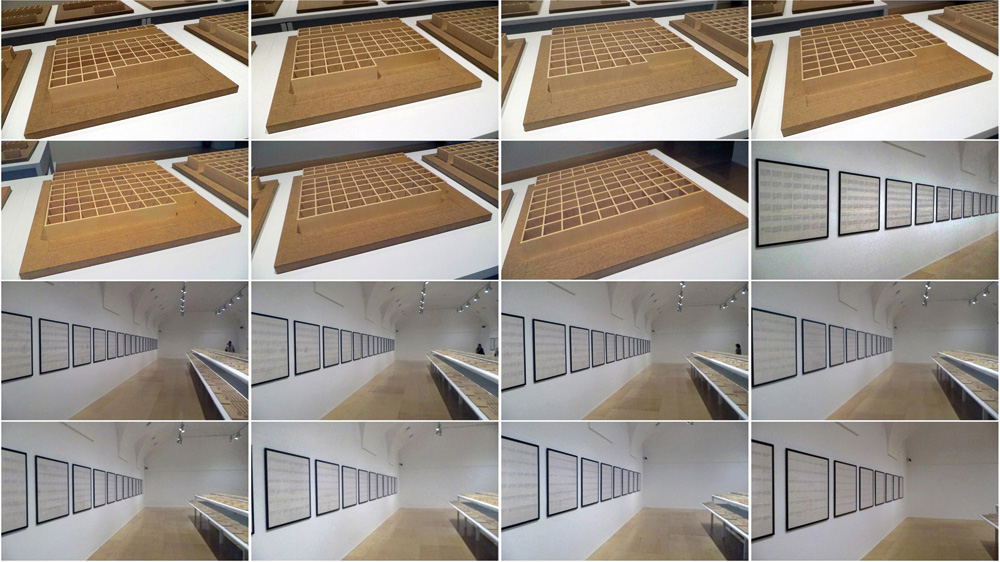
Is it possible to understand the work of the artist and composer Hanne Darboven (1941 - 2009) famous for her large scale installation containing thousands of drawings and notes? The project Zu / On Hanne Darboven is an exploration of herless known music in relation to her visual oeuvre. Abschliessend (In conclusion) is based on 1853 pictures handheld taken- as meticolous as possible - very close to the details of the works in the last space of the exhibition “The order of time and things. The home studio of Hanne Darboven” organised by the Museo Nacional Centro de Arte Reina Sofía and the Deichtorhallen Hamburg - Sammlung Falckenberg in collaboration with the Hanne Darboven. The music is the last part of Hanne Darbovens Requiem recorded in eleven volumes. The pictures are processed in still compositions frame by frame in a series of cycles increasingly compressing the original information.
Living and working in Amsterdam. Since the late 1980ties systematically exploring processes of perception and experience in installations and "films" referring inter alia to conceptual and minimal art, to the history of early cinematography , the transformation of information, the evolution of (new) media. Working with computer-generated processes combined with manual execution based on a growing photo archive containing at this moment more then 500000 pictures regarding major and minor personal and historic events. Main themes recently the reverberation of historic incidents and and the intertwined relations of culture. Thomas Mohr’s particular way of composing films since 2008 begins with smallest elements - taking single images. This material is processed in repetitive steps to higly compressed structures where the visual properties are almost dissolved. Since 2010 works specifically related to the body of work of Hanne Darboven. Now working on constructing an episodic memory covering the information of 30 years (1985-2015).
Ahmed Mohsen Mansour
No Time for Video
Video | hdv | color | 2:40 | Egypt | 2016
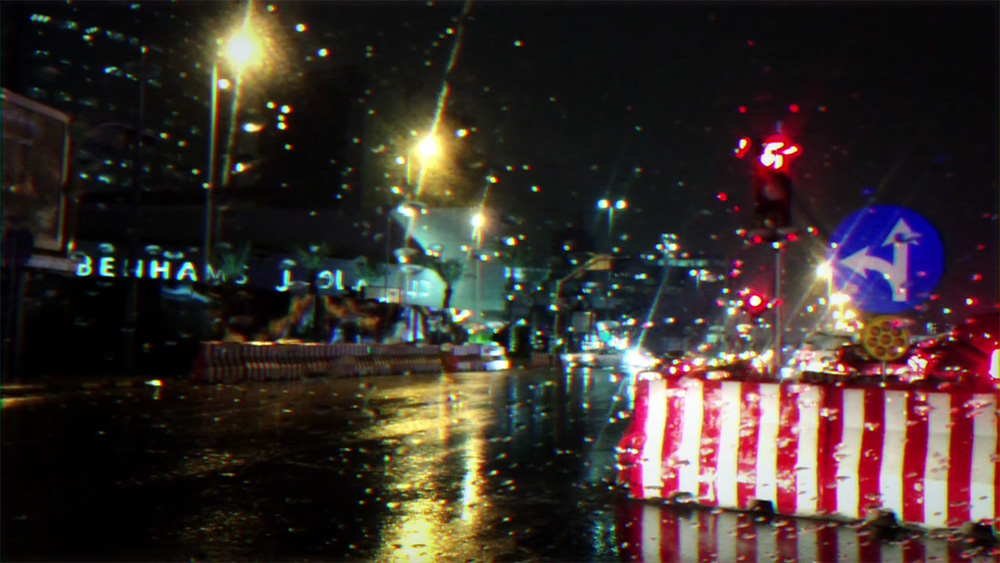
Time is the main determinant of the events, a dimension that defines the place of an object in the vast space More specific manner rather than relying on the three main dimensions (length - width - height) where you can not any event in the universe characterization without the addition of a fourth dimension. Thus, the movement of objects may be a relative change with time, and the concept of time is no longer a constant.
Ahmed Mohsen Mansour. Visual Artist born in October 1987, lives between Saudi Arabia and Egypt. Graduated from Faculty of Applied Arts- Advertising department, Recently I preparing MFA degree in Faculty of Fine arts – Graphic department- entitled “Installation Art as an Access to the Three Dimensional Ads Design”. Participated in several exhibitions and workshops in the fields of video, photography and animation in Cairo, Alexandria, London, Italy, Germany, France,Slovakia,Spain, Emirates and Saudi Arabia. Had a three experiments in the theatre field where I worked as an actor and assistant director in “The Hunchback of Notre Dame” and “The Ghosts," They are two theatre shows produced by “Woshosh” theatre group, also worked as a scenographer in “Inside the Mirror," another play produced by the same group.

Fernando Moletta
Eu, que ignoro tantas coisas, sei que ignoro uma a mais
Video | 4k | color | 10:0 | Brazil | 2022
The videoart “I, who ignore so many things, know that I ignore one more" is based on a short story by Brazilian writer Vilma Aguiar. The film aims to ponder between decisions, choices, and mistakes in order to understand the present and project the future through observations about the past, as the misunderstandings resulting from a time full of certainties led us to a hazy and fluctuating period between apathy, anesthesia, post-truth, torment, endless work-fun, euphoria, and fervor. Thus, aware of the yes and no, we could let ourselves be carried away by oscillations, abuse time, and get lost in it, in a lucid labyrinth.
Fernando Moletta is a visual artist and researcher (FBAUL). He holds a Master's degree from the Faculty of Fine Arts of the University of Lisbon. His artistic practice arises from an exploration of the challenges posed by modernism in contemporary times. Through an examination of temporal concepts and their intersections, he delves into the themes of failure, biopolitics, allegorical plasticity, and technological noise. These notions manifest as specters, hovering and intertwining to form a hybrid body of work that encompasses video, sculpture, and drawing. His recent exhibitions include solo shows such as "Three Sad Flawed" at the Gallery of the Faculty of Fine Arts of the University of Lisbon and "O que há entre o acima e o abaixo?" at the Museum of Art of Blumenau (Brazil), as well as group exhibitions including the 14th International Biennial of Contemporary Art in Curitiba (Brazil), "Drifting Time Misplaced" at Mono (Lisbon), "New future" at Industra (Brno, Czech Republic), and the 50th Contemporary Art Salon Luis Sacilotto (Santo André, Brazil). He has also participated in video and cinema festivals such as "Caminhos do Cinema Português" (Coimbra, Portugal) and the 36th Stuttgarter Filmwinter - Festival for Expanded Media (Stuttgart, Germany). He has taken part in artistic residencies at Duplex AiR (Lisbon) and Stalker/Mattatoio (Rome). His work has received awards and is part of the institutional collection at the Museum of Art of Goiânia (Brazil).

María Molina Peiró
The Sasha
Experimental film | 4k | color | 20:0 | Spain, Netherlands | 2019
On 1972 the astronaut Charles Duke landed on the Moon on the Apollo XVI. He was in charge of taking photos of the lunar surface with a high-resolution camera. ‘The Sasha’ is a film about the human perspective on Earth and our constant struggle with our temporal and spatial limitations. From the exploration of space to cyberspace, from an analogue Moon in 1972 to a virtual Moon in Google Earth today. A story about parallel universes where eternity seems to be lost between frames and interfaces.
María Molina Peiró is a Spanish audiovisual artist, filmmaker and researcher. Her film and installations explore layered realities that connect humans, technology and nature. She is particularly interested in memory systems (from geology to digital memory) and the relation between cinema and science. Her work has been shown internationally both in art venues and film festivals such as International Film Festival Rotterdam IFFR, Rencontres Internationales, BFI London Film Festival, Haus der Kulturen der Welt, International Film Festival Oberhausen, Louvre Museum, EYE Film Museum, ISEA Korea, Indie Lisboa International Film Festival, Washington National Gallery, London Science Museum, MACBA, National Museum of Modern and Contemporary Art (MMCA) Seoul, CCCB, Sevilla European Film Festival (SEFF), LOOP Videoart Festival, VIS Vienna Shorts, Hong-Gah Museum (Taipei), MATADERO (Madrid), Vilnius National Gallery, Taiwan Video Art Biennale, NABI Art Center, or Museum of Contemporary Art of Vojvodina amongst others. María holds a BA in Fine Arts from the University of Sevilla and graduated Cum Laude from the Master of Film at the Netherland Film Academy, where she is a current lecturer. Molina Peiro’s work has been supported and awarded in the last years with grants like Amsterdam Funds for the Kunst (3 Package Deal), AHK (Amsterdam University of the Arts) Award for Best Master´s project, Aesthetica Art prize (UK), Bloom Awards (Germany) among others. María Molina Peiro´s has participated recently in residency programs at Museum Quartier Vienna and Santa Fe Art Institute.

María Molina Peiró
One Year Life Strata
Video installation | hdv | color | 0:0 | Spain | 2018
During one year María Molina Peiró carried a wearable camera taking a photo every 30 seconds. The enormous collection of photos collected by the camera are shown in an online archive that instead of "remembering" creates a creative forgetting of the vast photo archive. One Year Life Strata proposes a visual metaphor of forgetting by transforming the digital images into what is likely the ultimate memory trace that will remain from us: The geological record. The project, in a sort of digital geology, mines the data from the strata and invite viewers to investigate one year of Maria Molina's life through an AI vision system, not concerned about personal memories but the collection of patterns and numbers they contain. In a society obsessed with recollection, data and monitoring One Year Life Strata addresses the disturbing territory of forgetting. Today that we have the tools to remember and archive almost everything, forgetting has become a term very close to death raising very similar fears. One Year Life Strata wants to overcome this fear and embrace forgetting in a game of time scales, where the speed of Digital Time is buried into a time difficult for us to grasp, the slow Deep Time.
María Molina is an audio-visual artist and filmmaker with a background in fine arts. She works in an open format mixing film, digital media and experimental animation. María Molina´s films and art works have been showcased in international museums like Haus der Kulturen der Welt (Berlin), EYE Film Museum (Amsterdam), MACBA (Museum of Modern Art Barcelona), Hong-Gah Museum (Taipei), Centre de Cultura Contemporània Barcelona (CCCB), MATADERO (Madrid) or Museum of Contemporary Art of Vojvodina (Serbia) among others. Her works has been featured in festivals like Rotterdam Film Festival, Art Futura (Barcelona), Taiwan Video Art Biennial, MADATAC (Madrid), VISS (Vienna International Film Festival) or Forecast Forum (Berlin). In her work she explores the increasingly blurred boundaries between material and digital realities. She is particularly interested in the convergences between different memory systems (from Geology to Digital Memory) and how the ubiquity and pervasive nature of Digital Technology is reframing our spatial and temporal perspective. Her films and installations often use metafiction, postproduction and geo-tools to unfold layered realities that connect humans, technology and nature. Her current research focuses on humanity's constant struggle with its temporal and spatial limitations, and how this struggle has driven civilisation and technology to change our relation with nature, time and our understanding of life itself.

Mercedes Molla Marfil
Normal envy
Video | dv | color | 1:8 | Belgium | 2009
I am in a supermarket. Instead of buying the products I need, I buy that ones that the others want. Does a product taste better when is desired by the others? A supermarket is a very common place in our daily life which represents well today`s capitalist system. Through my action I attempt to confront the idea of consumer choice and desire. Transcending the comic or quirky, the video promotes the possibility of a critical engagement with consumer values and cultural behaviour. It has without being propangandist a political agenda.
Mercedes Mollá (b. 1980, Valencia) received a Postgraduate Diploma in Fine Arts at Chelsea College of Art and Designed, University of the Arts in London. Studied her BA at Facultad de Bellas Artes de San Carlos in Valencia .With the Erasmus scholarship she studied six months at Winchester School of Art,UK. Recent solo exhibitions include Matuvu gallery, Brussels, Art Below, London; Imprevisual gallery, Valencia. Group exhibitions include Canvas Collectie , gallery on line ,Belgium; Really London?s gallery; Galeria de arte Kessler-Battaglia, Valencia. Mercedes is currently based in Brussels.

Christine Molloy, Christine MOLLOY
Moore Street
Fiction | 35mm | color | 5:35 | Ireland | 2004
Moore Street is a single tracking shot filmed on Moore Street in Dublin, Ireland. The film is in Swahili and English. For five minutes, we follow the thoughts of a young African woman in Ireland as she considers her past, her future, and her unfolding sense of identity as she walks along the city street at night. On the one hand Moore Street documents an iconic street in Dublin at an interval in its official re-development, where already the everyday hopes and dreams of new communities are reshaping the city as home. On the other hand it is a love letter whispered in the dead of night to an absent lover.
Christine Molloy and Joe Lawlor both hail from Dublin, Ireland. They are now based in London where they make film and video works for cinemas, the internet, sites and galleries. Moore Street is part of a series of 7 35mm short films by Molloy and Lawlor under the title Civic Life and was part of Ireland?s entry into the 2004 Sao Paulo Bienal.

Christine Molloy, Joe LAWLOR
Civic Life: Tiong Bahru
Fiction | 35mm | color | 19:55 | Ireland, Singapore | 0
TIONG BAHRU follows the lives of three characters of very different ages over the course of a day as they reveal to their families and friends their hopes and desires. Lyrical and musical in its style, the film is a sensitive portrait of 3 people caught at a crossroads in their lives and the extraordinary place in which they live. TIONG BAHRU is the latest and most ambitious film in CIVIC LIFE, the acclaimed series of short films by Christine Molloy and Joe Lawlor, through which over the last 8 years the artists have explored the themes of belonging, place, change and relationships. The films are developed through an extensive process of dialogues with communities and are made with casts of volunteers drawn from the areas in which they are filmed. Featuring 150 volunteers, many of whom had never acted before, TIONG BAHRU was shot on 35mm in the market and hawker centre of the art deco heritage estate of Tiong Bahru in Singapore in June 2010. ?TIONG BAHRU is the touchstone of (Molloy and Lawlor?s) work?restrained and lavish, formally audacious and sentimental? (Sight & Sound)
Born in Dublin, Ireland Christine Molloy (b 1965) and Joe Lawlor (b 1963) studied theatre in the UK in the late 80s. From 1992 to 1999 they devised, directed and performed in six internationally acclaimed touring theatre shows before shifting their attention towards moving image based work. Between 2000 and 2003 they directed a number of episodic, interactive works for the internet, and large-scale community video projects for galleries. Since 2003 Molloy and Lawlor have produced, written and directed 10 acclaimed short films, under the title CIVIC LIFE. All shot on 35mm, the CIVIC LIFE films have screened extensively around the world including screenings at the Telluride Film Festival, the International Film Festival Rotterdam, the Thessaloniki International Film Festival, the Sydney Film Festival and IndieLisboa. HELEN, their acclaimed debut feature film, premiered at the Edinburgh International Film Festival in June 2008 before screening at over 50 film festivals worldwide. TIONG BAHRU is the latest film in the CIVIC LIFE series.

Jonathan Monaghan
Escape Pod
Animation | hdv | color | 18:0 | USA | 2015
Escape Pod is a seamlessly looping 20 minute computer animated film chronicling a golden deer through glossy environments of wealth, power, and authority. Composed of one continuous tracking shot, the journey imagines a new reality devoid of human bodies, left only with material desires and ambitions of power.
Artist Jonathan Monaghan (born 1986, New York) creates animated video installations that challenge the boundaries between the real, the imagined, and virtual. Pulling from wide-ranging sources such as science fiction and baroque architecture, he creates bizarre, yet compelling, narratives and imagery with the same high-end technology used by Hollywood and video games. His work has been exhibited widely, including venues such as: The Sundance Film Festival, The BFI Southbank in London, The Hirshhorn Museum in Washington D.C., and The Crystal Bridges Museum of American Art. His work has been featured by The Washington Post, VICE, The Wall Street Journal, The Huffington Post, and The Village Voice.

Jonathan Monaghan
Mothership
Animation | hdv | color | 14:42 | USA | 2013
Salvador Dali meets science fiction in a fantastical vision from an alternate reality. Cows, superheros, video games, luxury hotels, and operating rooms seamlessly meld in a surreal exploration of value and power in the digital era. Trapped in an endless loop of seductive but ultimately vacuous simulation where meanings don’t quite materialize.
American artist Jonathan Monaghan (born 1986, New York) creates sculpture and animated video installations that challenge the boundaries between the real, the imagined, and virtual. Pulling from wide-ranging sources such as science fiction and baroque architecture, he creates bizarre, yet compelling, virtual environments and stories with the same high-end technology used by Hollywood and video games. His work has been exhibited worldwide in venues such as Bitforms Gallery in New York, BFI Southbank in London, Eyebeam Art & Technology Center, The Hirshhorn Museum in Washington D.C., and the Moving Image Art Fair London. His work has been featured by The Washington Post, Metropolis M, The Huffington Post, TimeOut NY, The Wall Street Journal and NYC TV.

Jonathan Monaghan
Den of Wolves
Video | 4k | color | 19:0 | USA | 2020
Den of Wolves is a seamlessly-looping video installation drawing on a range of references to weave a new multi-layered mythology. The work follows three bizarre wolves through a series of increasingly surreal retail stores as they search for the regalia of a monarch. Composed of one continuous camera shot, the work is an immersive, dreamlike journey drawing connections between popular culture, institutional authority and technological over-dependence.
Jonathan Monaghan is an award-winning visual artist who works across a range of media, such as prints, sculpture, and animation, to produce otherworldly objects and narratives. Drawing on wide-ranging sources, such as historical artworks and science fiction, his fantastical pieces uncover subconscious anxieties associated with technology and consumerism. Monaghan’s work has been exhibited at the Sundance Film Festival and the Palais de Tokyo in Paris, among other major venues. He has been featured in several media outlets, including The New York Times, Vogue Italia, and The Washington Post. His work has also been acquired by numerous public and private art collections, including The Crystal Bridges Museum of American Art and the Washington, D.C., Art Bank Collection.

Jonathan Monaghan
Rainbow Narcosis
Animation | hdv | color | 9:0 | USA | 2012
Rainbow Narcosis follows a headless lamb through hallucinatory and otherworldly environments. From the Palais Garnier in Paris, to a modernist loft, the film weaves a cryptic narrative of iconic subject matter relating to wealth and power. Like an alternate reality, elements from contemporary culture coexist with an antiquated past.
American artist Jonathan Monaghan (born 1986, New York) creates animated films that challenge the boundaries between the real, the imagined, and virtual. Pulling from wide-ranging sources such as science fiction and baroque architecture, he creates bizarre, yet compelling, environments and stories with the same high-end technology used by Hollywood and video games. Jonathan received his BFA from the New York Institute of Technology in 2008 and his MFA from the University of Maryland in 2011. His work has been exhibited worldwide in venues such as Bitforms Gallery, BFI Southbank London, The Hirshhorn Museum, and the Moving Image Art Fair. He has given lectures and workshops at the Glasgow School of Art, the University of Denver, and the Metropolitan Museum of Art. His work has been featured by the Washington Post, Metropolis M, The Huffington Post, TimeOut NY, the Colbert Report, ArtInfo and NYC TV. Monaghan is represented by Curator?s Office in Washington D.C

Guillermo Moncayo
Echo Chamber
Video | hdv | color | 19:0 | Colombia | 2014
Along the crumbling railways of a tropical country, a radio is broadcasting a climatological alert on loop: a natural disaster is looming This film is based on a very concrete reality, the gradual abandonment of Colombia’s rail network in the second half of the 20th century, reflecting the country’s complex relation to the notion of modernity over the decades.This is seen as a kind of intimate process of deconstruction of the territory’s imaginary cartography, like a reflection of the correlation between a physical landscape and its mental representation. A veritable “forward travelling shot” on the dilapidated rails of a collective memory, it tries to transversally examine the conditions in which the contemporary individual constructs the framework of his or her inner experience
Guillermo Moncayo studied film in Bogotá (Colombia) between 2003 and 2006. From 2007, he studied at the "École Supérieure d`Art d`Aix-en-Provence" [The Higher School of Art of Aix en Provence] which he graduated from in 2012. He is currently enrolled at the Fresnoy- Studio National des Arts Contemporains [Fresnoy National Studio of Contemporary Arts].His work, which encompasses video art, documentary film and photography, has been showcased at numerous events both in France and abroad. As regards the inspiration behind his work one might describe it as an exploration of the laws and effects of the geographical environment, consciously organized or not, on the emotions and behavior of individuals. It examines regularly the conditions in which the contemporary individual constructs the framework of his or her inner experience.

Jorge Moneo Quintana
Orbainak
Experimental doc. | hdv | color and b&w | 29:14 | Spain | 2019
The personal stories lived by the Uncle, the Father and the Son, respectively, form a tragic experience that is drawn along a line in time. This line is comparable to a crease in the pages of the family album, but also to a crack in the walls of the paternal house. It resembles the open wound created when drilling into a mountain, but also a scar in the collective imaginary of a society, where the idea of salvation finds its tragic destiny in the political struggle. What is at the end of that line? Will old war songs be enough to circumvent that destiny?
Born in Vitoria-Gasteiz (Basque Country) in 1988. He achieved his Bachelor degree at the University of the Basque Country and also carried out studies at Universitatea de Arta si Design din Cluj-Napoca (Romania) and Universidade de Vigo (Spain). Over the past few years he has developed his artistic career in visual arts and audiovisual media, enrolling in personal projects both as author, editor and cinematographer. His creations have been displayed in several cultural institutions and film festivals in Europe, Asia and America. He completed his film studies at ESCAC (Catalonia) and at the UAB-Universidad Autónoma de Barcelona (Catalonia) where he co-directed "The Interior City" that premiered at IDFA 2017. "Orbainak" ("The Scars"), his first film on his own, has been produced thanks to the Montehermoso Cultural Center grant and has participated into mentoring programes at IDFAcademy (The Netherlands) and Zlab (Basque Country). It premiered at Punto de Vista 2019 and has been awarded at Filmadrid 2019. He is currently finishing his next short film ?Begiak Hesteko Artean? (2020) and developing his first feature film 'Almanaka' (2021).

Caroline Monnet
Gephyrophobia
Experimental film | 16mm | | 0:0 | Canada | 2012
Gephyrophobia ? latin word for ?the fear of crossing bridges? - was shot in Ottawa/Gatineau, Canada. Inspired by pet architecture, a term coined by Japan?s Atelier Bow-Wow, and seeking to integrate the experience of the cinema into that of the city, the Situated Cinema references small buildings that have been squeezed into leftover urban spaces. The small cinema space, which can be demounted and which will travel to unorthodox locations across Canada, is intended to provide an alternative cinema-going experience: rather than constructing an immovable structure situated more or less permanently in the city, the Situated Cinema Project will construct a mobile micro-cinema that can be situated into various spaces, tapping into the flow and energies of the city. The cinema will screen a loop of five specially commissioned silent 16mm films from artists across the country.
Caroline Monnet is an award winning filmmaker and visual artist working in film/video, installation and printmaking. Her work has been exhibited extensively in film festivals and galleries, including the Toronto International Film Festival, Clermont-Ferrand vidéoformes (France), Urban Shaman Contemporary Aboriginal Art Gallery (Winnipeg), Künstlerhaus Bethanien (Berlin), Plug In Institute of Contemporary Art (Winnipeg) Cannes, WEYA (UK) and the Manguere Arts Centre (Auckland, NZ). Monnet is also part of ITWÉ, a trans-disciplinary art collective dedicated to the creation of Aboriginal digital culture. She works and lives in Montréal, Canada.

Alex Monteith
Chapter and Verse
Experimental doc. | 16mm | color and b&w | 91:0 | Ireland, New Zealand | 2005
?Alex Monteith?s haunting and haunted experimental documentary invites us to consider her images of Northern Ireland during this transitional time in terms of the troubles. Some are composed with limpid formal beauty, others in the hand-held style of news coverage, some in colour, others in black and white, and most of them are related only obliquely to the eloquent expressions of personal and political perspective heard on the soundtrack. Her open-ended, contemplative approach to representing the historical struggle is clearly influenced-as she is the first to admit-by Godard. So is her unerring editorial sense of the uses of duration and interruption to startle an already attentive audience. While we listen to a catalogue of the dead, the camera seems to scrutinize the landscape for signs of violence, and the effect is disturbingly akin to that of Resnais? footage of the abandoned Auschwitz in Night and Fog. The film was shot over three years in locations defined by the troubles, including the Bogside in Derry. It also looks at troubles-deaths of the small and often-bombed border town of Castlederg, County Tyrone.? ?Bill Gosden, director of the New Zealand International Film Festival. Chapter and Verse includes excerpts recorded with politicians, members of the security forces, relatives of victims of the troubles, religious figures and academics including Ian Paisley-First Minister of Northern Ireland, and Edward Daly-Bishop Emeritus of Derry.
Alex Monteith was born in Belfast, Northern Ireland in 1977. She is an artist, academic and experimental filmmaker and currently resides in Auckland, New Zealand where she is Head of Moving Image at the Manukau School of Visual arts, Manukau Institute of Technology.
Alex Monteith
Composition with RNZAF 3 Squadron Exercise Blackbird for three-channel video installation
Video | hdv | color | 15:16 | New Zealand | 2010
?onboard three grey Iroquis in military formation over Te WaiPpounamu?ridgetop alpine mists?tussock valley floors?radio communication... Award winning artist Alex Monteith collaborated with Royal New Zealand Air Force No.3 Squadron Leader Oliver Bint to compose a flight routine for three simultaneously flying RNZAF Iroquois helicopters. The action was performed during RNZAF Exercise Blackbird; a two weeklong search and rescue (SAR) training exercise based at Dip Flat at the northern section of the Southern Alps of New Zealand during the winter of 2010. Three helicopters fly maneuvers? in the line astern formation of banking turns in the Alpine areas of the isolated Leese Valley. Each helicopter was installed with identical rearward facing on-board HD cameras. The artworks key maneuver is a three helicopter simultaneous pedal-turn on a ridge-top; the only military maneuver of this kind ever developed specifically for an artwork. The video artwork contains no cuts. The audio is continuous intercom. dialogue between the radio operators at Dip Flat and the pilots in all three helicopters as they position and reposition to maintain the flight-plan.
Born Belfast, Northern Ireland (1977), Alex Monteith is an artist and academic based in Auckland New Zealand where she is a lecturer at the Elam School of Fine Arts, the University of Auckland. In 2008 she was awarded the Arts Foundation New Generation Awards, one of New Zealand?s most important bi-anneal awards for contemporary art and her video work Passing Maneuver 2008 was a finalist for the Walters Art Prize 2010. Her work is post-studio in orientation and often takes the form of performances, video art and large-scale actions with high-speed or high-risk cultures with radical sensitivities to geography.
Alex Monteith
Cascade Cove in the Shadow of 150,000 Bones
Experimental doc. | hdv | color and b&w | 13:0 | New Zealand | 2015
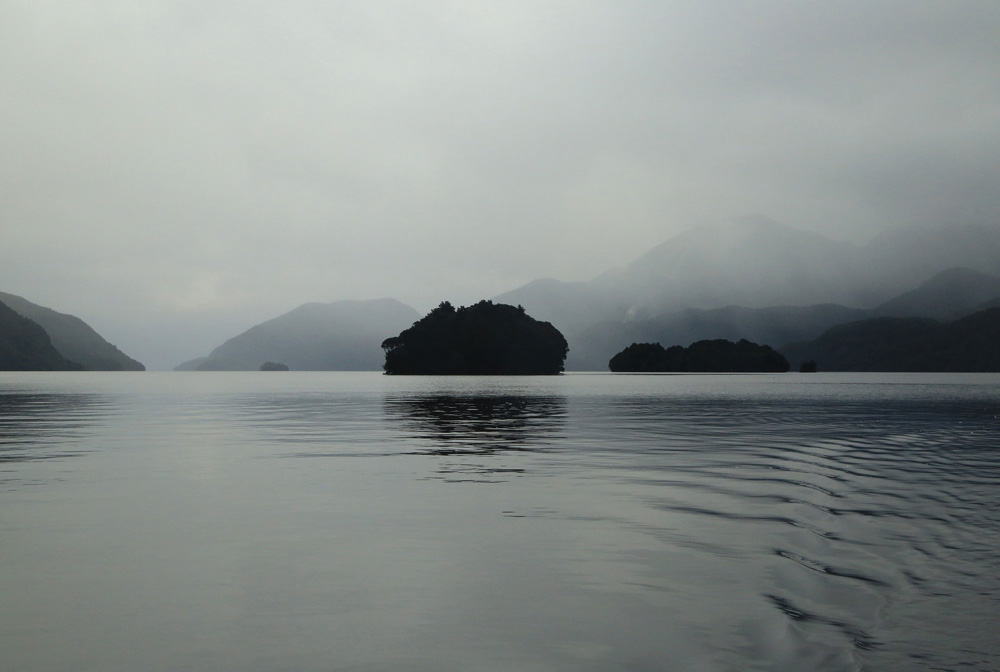
SYNOPSIS Film essay recorded in Aotearoa / New Zealand`s Cascade Cove, Tamatea / Dusky Sound; one of the wettest places on earth. After he had sailed there for the first time in 1770, James Cook spent more than two months in Tamatea in Aotearoa on his second journey in 1773. Cascade Cove within Tamatea is also near to the sites of the earliest archeological digs of the lower fiords of Aotearoa. The Begg Brothers, then in the modern era, Peter Coutts, each made various archeological incursions looking for and removing both settler and Maori material culture from the area. This film compiles observations of the intensity of weather atmosphere as a physical expression of tension between elemental forces, as a way of approaching a contested past in which European research methods overran already existing Maori knowledge production about the area. This film is part of an ongoing series of work about this area of Aotearoa.
Alex Monteith Biography (1977-) born Belfast, Northern Ireland, resides Tamaki Makaurau, Aotearoa resides in Piha, Aotearoa Alex Monteith’s works often explore the political dimensions of culture engaged in turmoil over land ownership, history and occupation. The works traverse political movements, contemporary sports, culture and social activities. Projects often take place in large-scale or extreme geographies. Recent surfing related actions connect the museum directly to local geography through participatory performance projects.

Marwan Montel, Sao Sopheak
Autour de La Folie Almayer
Documentary | mov | color | 49:2 | France, Belgium | 2022
La Folie Almayer est l'adaptation faite par Chantal Akerman du premier roman éponyme de Joseph Conrad ; Une histoire de passion, de perdition et de folie quelque part en Asie du Sud-Est que la cinéaste est partie tourner en 2010 au Cambodge. Présent sur le tournage, Sopheak Sao a filmé la cinéaste au cœur de son travail dans la végétation exotique et dans les eaux noires d’un fleuve qui ne semble mener nulle part. Les images qu’il a filmées ont, après un archivage de dix ans, été montées par Marwan Montel, et montrent combien le travail formel et esthétique prend le pas sur l’aspect narratif dans le travail de la réalisatrice belge. Une véritable plongée au plus près de l'artiste, et une occasion exceptionnelle de se glisser au cœur de son travail.
Marwan Montel (né à Istanbul en 2001) est un monteur et réalisateur Français. Suite à ses études à l'IAD en Belgique, d'où il sort diplômé en montage-scripte, il réalise un film documentaire d’archive sur le dernier tournage de fiction de Chantal Akerman.

Luján Montes
Intemperie
Experimental doc. | super8 | black and white | 9:0 | Argentina | 2014
"A walker understands gradually that he does not know much about the turbulent and airy flow of the spirit. Or he is incapable of defining it. Nevertheless, he connects with it every time he discovers that his own person constitutes a fragile material structure in the hands of nature’s fluctuations, far from social intermediaries. However, he adapts his definition of “natural” to the changes of his own mind: today is freezing because I freeze, tomorrow the sun burns because I dry out. Fragment of "The book of Haiku" by Alberto Silva.
Luján Montes (1980, Buenos Aires, Argentina) is a filmmaker, colorist and photographer. Her projects have been exhibited in numerous national and international festivals (BAFICI, Festival Internacional de Mar del Plata, London Analogue Festival, Festival Internacional de Cine de Centroamérica, Derhumalc) and have been shown in many art venues and museums (Museo de Arte Moderno de Buenos Aires, Palais de Glace, Casa de Cultural del Fondo Nacional de las Artes).

Muriel Montini
Adieu mon général
Fiction | dv | color | 58:0 | France | 2009
The month of July. Everything that makes a summer ; the beach, the bals, the encounters, the beginning of love stories?And the end.