Catalogue 2025-2026
Below, browse the 2025-2026 Rencontres Internationales catalogue, or search the archives of the works presented since 2004. New video clips are routinely posted and the images and text are regularly updated.

Claire Lance
A Homeward Bound
Experimental fiction | hdv | black and white | 9:9 | France | 2024
Through a hypnotic single-shot sequence, we are transported to the heart of a house, where negative black and white unveil an indefinite space between memory and bewilderment. Fluctuating beneath the social veneer, the gaze undergoes a metamorphosis as the house reveals its secrets; the walls themselves seem to whisper forgotten tales and unspeakable truths.
Claire Lance (born in 1987, France) is an artist who uses mediums closely related to human optics. Her projects explore cognition and the persistence of cultural images in perception through video, installation, and photography. Evolving over time, Lance's works often operate in a manner reminiscent of Rorschach tests, revealing what is generally invisible or described as intangible or non-objective. The global city, where scales and dimensions intersect in successive layers, creates virtual, intangible spaces accessible only to the eye. These indeterminate yet familiar places invoke the metaphor and persistence of images that we individually and culturally carry within us as viewers. Her works have been exhibited at the Ofr gallery in Paris, at the 39th FIFA in Montreal, Kurzfilmvoche Regesnburg, Germany, and have been featured multiple times in the British magazine Carpark. In 2023, she was invited by the CIRM (Centre International de Recherche Mathématiques) for a workshop titled 'Maths and Art: Common Creation'. She holds a master's degree in Practice and Theory of Contemporary Art from the Université Paris 8 Sorbonne. She has collaborated with various film directors as cinematographer on set, and commissioned works with press titles such as L’Obs, Trax, Technikart.

Andréas Lang
The Horses of Ani
Video installation | 4k | | 14:0 | Germany, Turkey | 2023
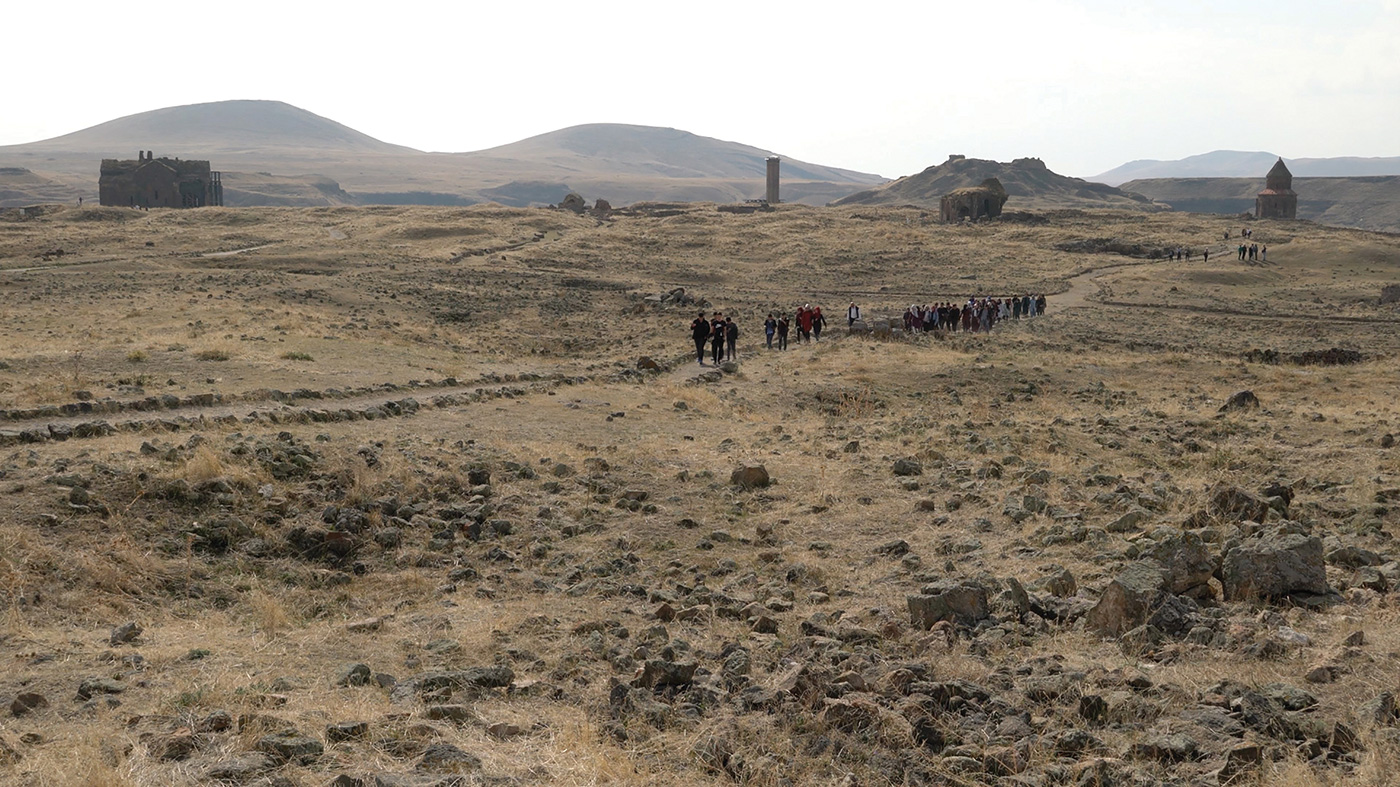
THE HORSES OF ANI 14.00 min. 2-channel video installation, 4K, stereo sound, loop camera and editing: Andréas Lang; sound-design: Jochen Jezussek; musical fragments of 2 Armenian duduks, from the Armenian medieval piece “Akna Krunk” (= song of exile), interpreted by Jordi Savall and Hesperion XXI Channel 1 On the plain next to the medieval ruin city Ani a group of wild horses walk towards the city walls where they used to graze. Just before the walls of Ani is now a construction site for a future parking lot and museum. The site is towered by a huge Turkish flag blowing in the wind, well visible from the nearby Armenian border. The horses enter the construction site, get confused and run around in panic. They finally find their way out and walk back into the endless plain. Channel 2 Sequence of the Akhurian (Turkish: Arpaçay) river in Kars. This river comes flowing from Armenia and passes Ani where it marks the frontier between Turkey and Armenia. The second sequence shows a group of students and tourists walking through the ruin field of Ani. Ani The ancient city of Ani was an important hub for trade caravans and the city controlled the trade routes between Byzantium, Persia, Syria and Central Asia. Merchants and craftsmen flocked to Ani from the older cities of Armenia, accompanied by a population flow from the rural areas. In 992, the Armenian Catholicosate moved its seat to Ani. The population of Ani was well over 100,000 and the wealth and prestige of the city were such that it was known as "the city of a thousand and one churches". Due to the many conquests, earthquakes and tribal raids over the centuries Ani degraded and was abandoned in early 19th century and left deserted. Before the 1915 genocide many Armenians still lived in the region, the ruin field of Ani stands symbolically for their disappearance.
Andréas Lang was born in Zweibrücken, Germany and began his artistic work in Paris, then Munich. Today he lives in Berlin and works with photography and video-installation. His image cycles deal with landscapes and their hidden history, including the intellectual and cultural DNA of Europe. 1999-2005 Photographs of European landscapes in relation to Romanticism, mythology and 20th century history. 2006-2008 Eclipse photography series on historical landscapes in the Middle East in relation to early Christianity and the Crusades. 2011-2024 Project on German colonialism in Central Africa, based on research into historical material. 2017 Photographs and videos about the Brazilian Quarter in Lagos, Nigeria, in relation to slavery and colonialism history. Since 2019, the project Re-Visiting Orientalism, superimposing 19th-century paintings in video installations with contemporary video sequences. From 2018-2023, the project Broken Memories about history and memory culture in Turkey. Since 2024 multimedia project on the historical population exchange between Turks and Greeks. His work has been shown internationally in museums, biennials, galleries and festivals. He has received numerous awards, including the German Photobook Award 2025 and 2023, the Special Mention Award at MDFF-Milano Architecture&Design Film Festival 2021, the Lotto Brandenburg Photography Art Award 2021, the Tarabya Cultural Academy Stipend 2018, the Berlin Senate's Work Grant for Visual Arts 2017.

Béatrice Lartigue
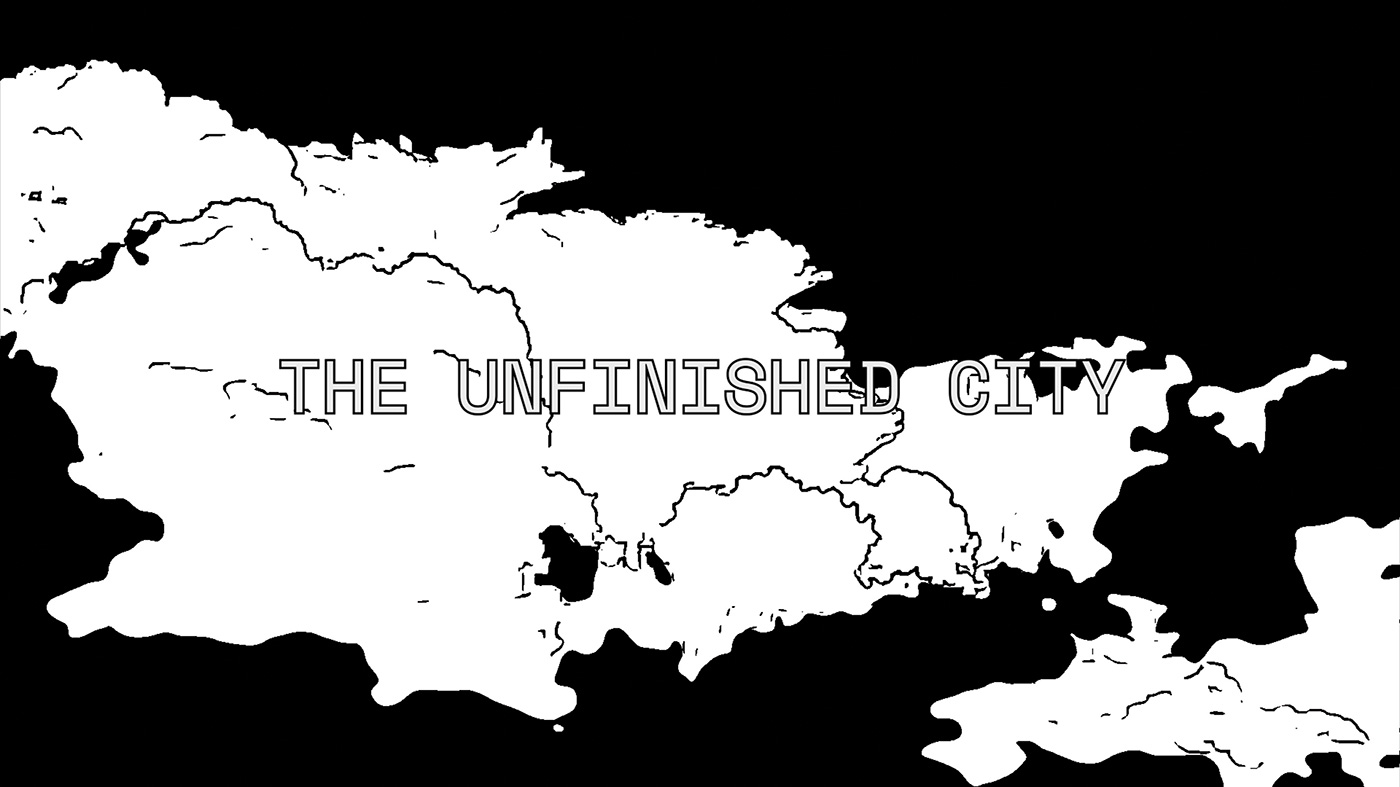
The Unfinished City
Experimental video | mov | black and white | 6:30 | France | 2025
A city as a dynamic evolving system where buildings, like living organisms, can grow and adapt over time. The Unfinished City explores the work of theorist, architect and urban planner William J. Mitchell (1944-2010), a professor at the MIT Medialab. Mitchell is the author of a trilogy that explores the impacts, challenges and potentials raised by the development of digital technology on the way we think about and design the city. “Since new technological systems are complex social constructions, we must understand our emerging options, choose our ends carefully, and build well. Our job is to design the future we want, not to predict its predetermined path. [...] Ultimately it comes down to a basic social and political choice. What will we use the multifaceted and sometimes contradictory affordances of digital technology for?”, e-topia: "Urban Life, Jim—But Not As We Know It", 1999, The MIT Press The Unfinished City takes a subjective, dreamlike perspective on the themes Mitchell sketched out over 25 years ago. The fragmented, shifting city that takes shape before our eyes becomes the film's main protagonist. Thought of as a living organism, this architecture also echoes the thinking of the Metabolist movement that emerged in Japan in the late 50s. Metabolism views cities as dynamic, evolving systems where buildings, like living organisms, can grow and adapt over time. The film combines "traditional" animation techniques with Machine Learning tools.
Béatrice Lartigue is a french visual artist based in Toulouse. She is co-founder of the interdisciplinary collective Lab212. Since 2008, Béatrice Lartigue has been working on projects at the intersection of art, science and technology. Her work explores the materialisation of invisible physical events, by immersing visitors in a space whose rules are partly written and partly in the making. A critical perspective on the utilisation of technology in a fragile environmental context guides her practice. Her works were exhibited at the Barbican Centre (London), the Miraikan Museum (Tokyo), le Centre Pompidou (Paris), la Gaîté Lyrique (Paris), the DMuseum (Seoul), the Times Art Museum (Beijing), Photo Elysée (Lausanne). Béatrice Lartigue has won several international awards, including from the Sundance Film Festival (New Frontier Selection: Notes on Blindness), the Lumen Prize (Performance Award: Portée/), the GIFF Festival (Philémon). She teaches Media and Interaction Design at Gobelins (Paris) and regularly leads workshops in institutions such as ECAL (Lausanne), Beaux-Arts (Toulouse).


Daphné Le Sergent
Silicon Islands and War
Experimental doc. | mov | color | 37:0 | France | 2025
A l’heure où l’IA connait un développement sans précédent, la technologie des semi-conducteurs est devenue stratégique dans l’échiquier mondial. Sans les semi-conducteurs, le développement des moteurs des intelligences artificielles ne peut avoir lieu. Sans les semi-conducteurs, pas d’armement de pointe, de mémoire numérique, ni même encore de capteur pour nos appareils photo numériques. Cet essai vidéo invite à considérer une autre histoire de la photographie, une histoire où la résolution de nos images monte en gamme à mesure que l’industrie asiatique (Japon, Taïwan, Corée du Sud) miniaturise les semi-conducteurs, gravés sur des plaques de silicium (silicon). Mais cette course en avant dans la technologie ne se comprend réellement qu’en regard de son contexte géopolitique de la zone Pacifique et la guerre économique entre la Chine et les US. Comment alors ne pas entrelacer le récit de l’évolution de nos images avec l’histoire de ces pays - intitulés ici Silicon Islands -, ainsi qu’avec leurs guerres passées et conflits actuels ? Au récit impersonnel des voix générées par IA, y répond celle d’un conteur créole. Ce dernier défie le gigantisme de la mémoire numérique et son flot démesuré d’images. Il la défie avec les outils de la mémoire orale : la poésie et le chant.
Daphné Nan Le Sergent mène un travail artistique et théorique sur les différentes spatialisations du sensible et sur une image comme forme de mémoire sensorielle dans les arts occidentaux et non-occidentaux. Ses projets artistiques explorent l’image photographique vis-à-vis de la chaîne de production de ses matériaux et des équilibres économiques et géopolitiques qui la maintiennent alimentée. En 2021, la vidéo L’image extractive propose une histoire alternative de la photographie argentique en lien avec celle de l’extraction minière de l’argent, de la fluctuation des cours boursiers et de la menace de tarissement du minerai.

Patrik Lechner
Heumarkt
Multimedia performance | 0 | color | 7:0 | Austria | 2025
The short film 'Vitrine' is a gesture of dedication to an object. The “Café am Heumarkt” houses a now-defunct display case, whose sounds, in past decades, often provided the only break in the otherwise concentrated silence of afternoons in the coffeehouse. This gesture originated from the research project Spirits in Complexity – Making Kin with Experimental Music Systems, initially taking the form of an installation that sonically reanimated the display case. The short film represents a further step in this direction: through procedural modelling, the display case was recreated both sonically and visually. No photos, 3D scans, or audio recordings were used—instead, the foundation of the modelling and exploration was a deep engagement with this culturally charged object. The result opens up various fields of action—legible as an archival object as well as a peculiar, audiovisual, real-time capable “instrument,” whose aesthetic possibilities are explored here. “Europe as a museum,” a form of escapism stuck in time, becomes particularly tangible in Viennese coffeehouses. This very anachronism, along with the general discrepancy between tradition and technological progress, is addressed here on an aesthetic level. Video made with TouchDesigner, Audio made with Max/MSP.
Patrik Lechner (AT) is an artist creating experimental audio/video content since the mid 2000s. Developing custom software for these purposes, original content in abstract sound works and real-time 3D graphics arose through the exploration of technology without losing focus on artistic expression. Patrik Lechner held audio/visual performances in Austria, Belgium, Italy, Bulgaria, Germany, Canada, Dubai and MUTEK Mexico and regularly played at the Austrian Pavilion at the world exhibition in Shanghai 2010. He received an honorary mention at PRIX ars electronica 2019 for a musical piece written for an acousmonium.
Jangwook Lee
Chang Gyeong
Experimental film | 16mm | color and b&w | 17:20 | Korea, South | 2024
"She would narrate events she had witnessed with her own eyes, as well as events that she had never witnessed." from 'The wind-up bird chronicle' by Murakami Haruki As a child, zoo was a space that gave me a very fantastic experience. In particular, Changgyeonggung (then called Changgyeongwon) was a strange place where zoo, amusement parks and old palaces coexist. Perhaps childhood memories remain as an emotional vestige of events there, of people with whom, of food, of weather, etc. It was not a specific event, but a personal emotion which lies somewhere around the boundaries between the reality and the virtual. It was learned through education that the coexistence of these elements came from the tragic modern history of Changgyeonggung (in the time of Japanese rule, a zoo was created for the purpose of mocking and degrading Changgyeonggung Palace). Even then, Changgyeonggung has a history of animals being victimized during liberation and the Korean War. After learning of this history, the space of Changgyeong Palace no longer had aroused any previous emotional reactions. Emotional memories that had formed the ambiguous boundaries between reality and fantasy began to divide exactly in two, and at the same time there was no emotion left on either side of reality and fantasy.
Lee Jangwook studied filmmaking at the School of the Art Institute of Chicago (SAIC). He has been working on film materials and expanded cinema such as live film performance. In 2004, Space Cell was founded to hold experimental films and hand-made film workshops and is currently underway. Many of the works are archived in the Korea Film Archive and ACC. His works have been shown at festivals and exhibitions like Tate Modern, National Museum of Modern and Contemporary Art (MMCA Seoul), Asia Culture Center (ACC Gwangju), FID Marseille, Internationale Kurzfilmtage Oberhausen, Jeonju International Film Festival, and EXiS.


Cathy Lee Crane, John Di Stefano
Tra
Video | hdv | color | 5:35 | USA, Canada | 2024
‘Tra' is an ode to Italian filmmaker Pier Paolo Pasolini. ‘Tra' synthesizes the narrative of his film ‘Teorema' (1968) by highlighting its interstitial moments. The act of running that appears throughout the film is isolated and deployed to expose the film’s subtextual currents.
John Di Stefano is an artist/filmmaker, writer, and curator whose work reconciles the personal with the social, the everyday with history through hybrid forms of documentary practices and the essayistic form. His work often deals with his immigrant past seen through a queer lens, including the feature-length 'You Are Here' (2009) which premiered at the Festival International du Documentaire (Marseille). His award-winning work has also been featured at the Videonale (Bonn), Whitechapel Gallery, Tensta Konsthall, Barcelona Museum of Modern Art, Para/Site (Hong Kong), and Anthology Film Archives. His critical writings appear in various international publications. He teaches at Concordia University (Montreal). Cathy Lee Crane is an experimental filmmaker whose work mines the historical archive to produce lyrical films of speculative history. She was a Guggenheim Fellow, and in 2015 her work enjoyed its first survey at the National Gallery of Art (Washington DC). Crane’s award-winning films –including 'Pasolini’s Last Words' (2012)– have screened at Viennale, Cinematheque Francais, BFI, and Arsenal/Berlin. Her interest in borders saw the release of 'Crossing Columbus' (2020) about the border town of Columbus, New Mexico which was supported by the Rockefeller Foundation and the Harun Farocki Institut in Berlin. She teaches at Ithaca College (New York).

Thomas Leon
To Ashes
Video | 4k | color | 5:6 | France | 2025
To Ashes explores the thresholds between reality and machinic hallucination, questioning contemporary image-generation technologies — particularly artificial intelligence — and their influence on our perception of the real. Created through a hybrid process combining 3D modeling and AI-based generation tools, the video unfolds as a continuous tracking shot through a brutalist megastructure in constant transformation. Architectural forms disintegrate and transform, while ash-like particles rise into the air. This disintegration is accompanied by an experimental soundscape, where analog synthesizers and transformed voices evoke a latent collapse. Gradually, the architecture gives way to unstable crystalline structures. Reality wavers. In the end, something gives way, shifts, disappears. Everything must burn.
Thomas Léon develops his practice by merging cinema, graphic arts and images from new technologies. He creates films, immersive video and sound installations, as well as large-format drawings. His work explores the interconnections between memory, sensuality, intimate experiences, and the imaginary, drawing on fictions, whether they be social, urban, climatic, etc. He is notably influenced by science fiction and utopian literature and frequently develops his projects using contemporary image creation tools (3D modeling, AI, etc.). He regularly participates in screenings or exhibitions in France and abroad: 'Listening to Transparency' at the Minsheng Art Museum in Shanghai (China, 2017), 'Cruces Sonoros: Mundos Posibles' at the MAC in Santiago de Chile (Chile, 2016), 'Rendez-vous 11' at the Institute of Contemporary Art in Villeurbanne (France, 2011), and at the South African National Gallery in Cape Town (South Africa, 2012). He notably took part in residencies : Drawing Factory organized by CNAP (National Center for Visual Arts) and the Drawing Lab (Paris) in 2021 ; a residency in Taiwan, organized by Grame, the National Center for Musical Creation (Lyon), and the Digital Art Center (Taipei) in 2011. His works can be found in the collections of CNAP (National Center for Visual Arts) and the Louis Vuitton Foundation. Thomas Léon lives and works in Montreuil.


Leopold Emmen
Another Woman - film adaptation (work in progress)
Video installation | mp4 | color | 13:6 | Netherlands | 2025
'Another Woman - film adaptation' is a three channel film presenting intimate scenes of three characters, two women and a man, in the course of a breakup. The film explores a world of fiction and performance in a cinematographic and spatially designed narrative where three images are presented simultaneously. The visual style focusses both on the performing bodies and their surroundings. Subcutaneous emotions surface through tactile interaction, as the characters touch and feel their place amidst the physical properties of the space. Walls, ceiling, floor, curtains and furniture form obstacles, boundaries and voids that confront the protagonists with the situation and state of mind in which they find themselves. The interiors become mirrors for their inner worlds, surreal and intuitively recognisable at the same time. 'Another Woman - film adaptation', 2025, is a re-staging of the spatial installation 'Another Woman', 2022. We show an exerpt of 13 min 6 sec. of the final film that will have an estimated duration of 70 minutes.
Leopold Emmen is a collaboration between filmmaker Nanouk Leopold and visual artist Daan Emmen. In our work, we experiment with film as a spatial, cinematographic experience in which the visitor plays an active role. Through the characteristics of a place and the behaviour of our protagonists, we want to make tangible how a presence influences life and relationships with the other. An open invitation to explore the physical and mental world of the characters themselves. Creating awareness of the way in which space, sound and moving image can come together in a deepening, embodied experience, we want to stir up our conditioned gaze. Reflecting on how we see the world, how we see ourselves in that world and how we see each other.

Sonia Levy
We Marry You, O Sea, as a Sign of True and Perpetual Dominion
Experimental doc. | 4k | color | 19:28 | United Kingdom, France | 2025
We Marry You, O Sea engages with Venice and its lagoon “from below,” with the aim of focusing attention on the city’s submerged, life-giving, and altered bio-geomorphological processes rather than on its often-recounted political and military histories. Underwater filmmaking opens new ways of knowing the materialities of the Venice Lagoon and exposes a fractured and troubled environment that complicates mainstream historical narratives that start above the water’s surface. By attuning to the ebb and flood of the lagoon, we start sensing the interplay between land and water, life and decay, and the intimate processes shaping this environment. Noticing the kinds of life made possible in this damaged watery space compels us to delve into the ways it has been profoundly transformed. We Marry You O Sea as a Sign of True and Perpetual Dominion takes its title from the words uttered during the Venetian ritual The Marriage of the Sea, which was held annually on Ascension Day between the eleventh and eighteenth century. During the event, the Doge, the patriarch of the Venetian Republic, would wed the lagoon by casting a golden ring into the water, declaring dominance over the sea. The artist reframes Venice’s enduring relationship with its permeating waters by reflecting on this ongoing legacy of quests for mastery over watery environments. How, this work asks, might we imagine different futures for Venice if we begin to experience the lagoon as a lively place populated by manifold ways of living and dying? In the lagoon, a space requiring continuous modifications for human settlement, wetlands and infrastructures have long been intertwined. Venice’s consolidation as a trading hub and epicenter of naval advancement during the Middle Ages prompted major hydrological engineering to maintain the lagoon’s shallow depths for defense purposes. However, in the twentieth century, harrowing modernization transformed parts of the wetland into petroleum refineries and one of Italy’s largest container terminals as part of an effort to turn the lagoon into an industrial frontier. Urban anthropologist Clara Zanardi has described how these transformations spatialized class divisions in a new way, while also causing irreversible ecological degradation that has profoundly altered the lagoon’s lifeways. The film presents these histories of modernization by interweaving rare historical photographs from Venice’s Giacomelli Photographic Archive with submerged perspectives of the present conditions of the lagoon. The historical significance of these photographs is emphasized by the negative black-and-white reversal of the submerged perspectives, connecting past and present and unfolding futures within the lagoon’s contaminated waters. An original score, created by a chorus of human voices and underwater sound recordings, further emphasizes the links between submerged spaces and human domains. The composition captures the lagoon’s pulses and the impact of industries—from aquatic sounds drowned out by boat noises to the rhythmic poundings of industrial activity amid surging tides—as it gestures toward the profound interplay between human activities and the lagoon’s shallows.
Sonia Levy is an artist filmmaker with a Berber-Polish background. Her work, marked by site-specific and interdisciplinary inquiries, delves into the implications of Western expansionist and extractive logics, exploring how these forces manifest in the transformation and governance of hydrosocial worlds. Her practice aims to probe the thresholds that have shaped and influenced the conditions necessary for life to flourish.


Douna Lim, Théo Pesso
Millennium
Documentary | 4k | color | 55:33 | Korea, South, Japan | 2024
Le 31 décembre 1999, des anonymes filment leur soirée de passage au troisième millénaire. Derrière et devant leurs caméscopes amateurs, ils mettent en scène leur attente de cet événement aussi historique que dérisoire. Dans la fête, chez des proches ou dans la rue, les filmeur-se-s enregistrent les détails de leur vie intime, dans l'idée de laisser un témoignage de ce passage à une nouvelle époque. À travers un montage d'images issues d’internet, le film propose une nouvelle perspective sur le processus de construction des récits de fin du monde.
Douna Lim est artiste vidéaste et plasticienne. Depuis 2022, elle est chercheuse et enseignante au département des arts visuels de la HEAD–Genève (HES-SO). Sa pratique, à la croisée de la vidéo, de l’installation et du dessin, s’intéresse à l’archive comme matériau vivant et interroge la mémoire à travers des gestes expérimentaux. Théo Pesso développe une pratique qui relie film, photographie, performance et musique. Son travail explore l’économie de la production des objets culturels dans leurs dimensions politiques, sociales et commerciales, ainsi que la manière dont ceux-ci circulent à travers différents cadres discursifs et culturels. Les deux artistes collaborent depuis 2014 et co-réalisent Mario 101 (2019), Preparadise Sorry Now (2021) et Millennium (2025) soutenu par la DRAC-Île de France. Leur travail est présenté en France (Fondation d’Entreprise Pernod Ricard (2019), Glassbox (2021) à Paris ; Café des Glaces (2021) à Tonnerre) et à l’internationale : Forde (2025), Halle Nord (2021) à Genève, Roehs Gallery (2020) Zurich ; Biwako Biennale (2018) Omihachiman, Japon) et a fait l’objet du Prix Gertrude Hirzel en 2021 et des Bourses Déliées du Fond Cantonal de l’Art Contemporain à Genève (2020).


Frédéric Liver
Dansul Satului
Experimental fiction | 4k | color | 30:0 | France, Romania | 2024
Through a series of encounters with workers, their environment, and their activity, "It could have been... gold" is a series of portrait films exploring apprenticeship. Dansul Satului, the first film in the series, plunges us into the Romanian village of Schela. Like a diary, it shows the life of the village, its inhabitants, and the work they do day after day. We meet Cristi, a stone wall builder, and Emil, a woodworking enthusiast. We made a wall, and a wooden railing and celebrated Madalin's birthday. In the old days, the village held a dance party every Sunday. The elders used to observe the younger ones, and if someone saw that a guy was a good dancer, they thought he was a good worker. The name was "hora satului".
Frédéric Xavier Liver is a French-Italian artist whose multidisciplinary practice spans film, performance, and installation. His work explores the processes of learning, endurance, and vulnerability as means of reflecting on transformation and shared experience. Often initiated by a physical or personal challenge, his projects develop through encounters, gestures, and repetition, revealing how memory and emotion inhabit the body. At the crossroads of visual art and performance, he creates works that combine observation and participation, blending poetic sensibility and artistic research. He lives and works between France and Belgium.


Jan Locus
Intruders
Experimental film | 0 | black and white | 6:5 | Belgium | 2025
Intruders explores the boundary between science fiction and reality, investigating themes of reverse colonization, ecology and human environmental impact. The film offers an introspective reflection on the Western fascination and fear of extraterrestrial entities. In an elongated pan, mountain landscapes and misty images of animals are presented in an ethereal, ghostly way. Locus does not use conventional film footage, but found footage online hunting videos and black and white photographs of UFO observations from the 1950s and 60s. Although these images reveal their origins through their grainy texture, Locus removed the UFOs from these photos to seamlessly merge the remaining landscapes. The phenomenon of unforeseen animal death, often reported in UFO sightings, serves as a metaphor for human influence on nature. Locus intertwines photography with video to create a complex narrative that emphasises the ambiguity of reality and fiction. The film reflects on ‘intruders’ in nature, inspired by dystopian visions of the future and challenges the viewer to consider the complex and often disturbing relationships between humans, technology and nature.
Spanning the mediums of film, photography, and sound, his work often addresses landscape as a tool for the creation of national and social identities, focusing on environments altered by extraction and industrialization. In his latest work, he explores the tension between found footage, still photography, and the moving image, emphasizing the ambiguity of our perception of reality and fiction. His films have been presented at numerous international festivals, including the International Film Festival Rotterdam (IFFR), the International Short Film Festival Oberhausen, Rencontres Internationales Paris/Berlin, Le FIFA – International Festival of Films on Art (Montreal), Kasseler Dokfest, Asolo Art Film Festival, Stuttgarter Filmwinter, CROSSROADS Film Festival (San Francisco), ANTIMATTER Media Art (Victoria), Festival ECRÃ (Rio de Janeiro), PROYECTOR Plataforma de Videoarte (Madrid), SPLIT Film Festival, ONION CITY Experimental Film Festival (Chicago), BISFF Beijing International Short Film Festival, and Flight / Mostra Internazionale del Cinema di Genova among others. Locus lives and works in Brussels.


Sophie Loesch, Erja Andrea
Grimms Albtraum
Documentary | dcp | color | 23:42 | Germany | 2025
The wolf is back, warned the mother Little Red Riding Hood. Social imprints reflect in collective stories and narratives - as in the fairytale ‘Little Red Riding Hood’. But what happens if fiction and reality become blurred and the fairytale suddenly finds itself in right-wing rhetoric? Documentary Folk Horror about right-wing rhetoric and the figure of the ?problem wolf ? as a subject of projection regarding social and national borders - a reinterpretation of the fairytale ‘Little Red Riding Hood’.
Andrea Erja studied cultural and social anthropology at the University of Vienna, specialising in media and visual anthropology. In addition to her studies, she has supported various documentary film festivals, such as Ethnocineca in Vienna and DOK.fest Munich, in various areas of activity. Since October 2022 she is studying documentary film directing and television journalism at the University of Television and Film Munich. Sophie Loesch graduated with a Bachelor's degree in Social and Cultural Anthropology and Art History and interned at DOK.fest Munich. Since Fall 2022 she studies Documentary Filmmaking at University of Television and Film Munich.


Lesley Loksi Chan
Lloyd Wong, Unfinished
Experimental doc. | 0 | color | 28:49 | Canada | 2024
In the 1990s, Chinese-Canadian artist Lloyd Wong began a video work about his living with HIV. It remained unfinished. Thirty years after his death, Lesley Loksi Chan edited the material. Rough and unprocessed, this film explores the meaning of incompletion.
Lesley Loksi Chan is an artist and filmmaker. Her practice is concerned with questions of invisibility, believability and resistibility. Her work asks how material culture and image culture affect the particular ways we think, remember, and live together. Through experimental, handmade and process-based filmmaking, she creates moving-images as mementos.

Gabriela Löffel
We do not have to know each other in advance
Video installation | hdv | color | 20:15 | Switzerland | 2024
« We do not have to know each other in advance » is a hybrid video work that alternates moments of dance performance with archive footage and textual quotations. Gabriela Löffel draws on the political aspect of public space to construct her thinking, developing a visual essay that stages the ‘performativity of bodies in this zone of political action’. Drawing on the written work of Judith Butler, an American philosopher and gender theorist who has worked on the question of the body and its normalised representativeness in contemporary society, Löffel gives corporeality to the issues raised by the author. Quotations from Butler's work are shown alongside the danced and archival elements of the video. The almost fixed camera allows us to examine in detail the slow, precise movements of the dancers. The camera's movements are almost imperceptible, so subtle are they. The artist and choreographer Cédric Gagneur worked closely together to define the various movements that make up the choreography: they propose an abstraction of gestures of resistance or revolt, drawn from archive images from the collection of the Archives contestataires de Genève. The piece is inhabited by slowness and silence, giving the body enough space to unfold individually or collectively. The work offers a dialectic of the potential for protest in the public space. Co-produced by the Fonds cantonal d'art contemporain and the Fonds d'art contemporain de la Ville de Genève for the Mire program.
Gabriela Löffel mainly works with time-based media and focuses on the zones of political and finance structures, and infrastructures. Shifting and translating from the documented immediate to the fields of interpretation and mise-en-scène are strategies she uses in her work process. A method that often results in long-term projects and enables her to create spaces for questions and to propose disruptions to linear narratives. She is interested in the obliquity of the subject and his context. It’s in this gap, brought about by her way of addressing subjects, that her work opens onto reflections on the sense of how we understand a world when we become conscious of the fragmentation of our knowledge. Her work has been presented at institutions and galleries including MAST Bologna, Aargauer Kunsthaus, EMAF Osnabrück, Galería Metropolitana Santiago, Dazibao Montreal, and the Kochi-Muziris Biennale among others. Gabriela Löffel is a recipient of the Swiss Art Award, the Lewis Baltz Research Fund, the Landis+Gyr Grant, as well as others.


Margit Lukacs, Persijn Broersen
Lion's Court
Video | 4k | color | 20:0 | Netherlands | 2025
Lion’s Court is a cinematic short opera in which the Binnenhof—the seat of Dutch Parliament in The Hague—is reimagined as a virtual stage where history dissolves into myth. Inspired by the discovery of 14th-century lion bones at the site and by stranded whales as omens, Lukács & Broersen collaborated with composer and political scientist Bram Kortekaas to reinterpret Goethe’s Faust’s vision of redemption. At its center stands the lion Faust, sung by baritone Michael Wilmering—a despot in pursuit of a freedom that consumes itself, a mirror of imperial ambition on the verge of collapse. The artists also drew on the 1650 writings of Johan de Witt, the republican Grand Pensionary, whose words are voiced by the whale (alto-mezzo Carina Vinke), rising from beneath the flooded foundations of the Binnenhof. De Witt believed that a true republic is not ruled by the whims of a single individual, but rooted in the principles of freedom and equality—the very foundations of democracy. In Lion’s Court, a digital hortus conclusus unfolds: a fluid, enclosed world where power, morality, and prophecy converge, and where the myths of the past reverberate through the politics of the present.
Margit Lukács and Persijn Broersen are an Amsterdam-based artist duo exploring the entanglements between nature, culture, and technology. Their work includes films, digital animations, and spatial installations that investigate how media shapes our perception of the natural world. Graduates of Graphic Design at the Gerrit Rietveld Academie, they completed their MFA at the Sandberg Institute and were artists-in-residence at the Rijksakademie in Amsterdam. Broersen & Lukács’ practice is rooted in media theory, art history, and mythology. Drawing from cinematic, scientific, and historical sources, they reimagine landscapes and natural phenomena through digitally layered environments. Their work often reflects on the politics of representation and the appropriation of nature, reconfiguring dominant narratives through fragmented, multi-perspective storytelling. Their installations and films have been widely shown internationally, including at the Stedelijk Museum Amsterdam (NL), Centre Pompidou (FR), FOAM (NL), MUHKA (BE), Centraal Museum (NL), MacKenzie Art Gallery (CA), WRO Biennale (PL), Biennale of Sydney (AU), Rencontres Internationales (HKW Berlin, Louvre/Grand Palais/CWBP, Paris), and Wuzhen Biennale (CN). In 2024, they represented the Netherlands at the Gwangju Biennale. Their film I Wan’na Be Like You was nominated for the Tiger Award/IFFR 2024.


Ewan Macbeth
Facade
Experimental fiction | 4k | black and white | 5:25 | Netherlands | 2025
A burn survivor dwells on the incident that scarred him, unraveling a tale of malpractice and the devastating cost of putting profit over people.
Ewan Macbeth (b. 1992) is a Scottish filmmaker based in Rotterdam (NL) and Edinburgh (UK). After studying Fine Art Photography at the Glasgow School of Art, he completed an MA in Lens-Based Media at the Piet Zwart Institute. His work has been shown at the International Film Festival Rotterdam, Rencontres Internationales Paris/Berlin, Ji.hlava International Documentary Film Festival, European Media Art Festival Osnabrück, Eye Filmmuseum Amsterdam, TENT Rotterdam, CCA Glasgow, and RSA Edinburgh, among others.
Ruth Maclennan
All The Tears In The Sea
Experimental doc. | 4k | color | 36:0 | United Kingdom, Norway | 2024
All the tears in the Sea is a letter from the remote Svalbard archipelago, where global heating and Russia’s invasion of Ukraine disrupt the fragile Arctic ecology. Temperatures and geopolitical tensions are rising. Svalbard is a place of extremes, contradictory and fractured: cosmopolitan, yet determinedly Norwegian, built on coal mining yet vaunting its eco-credentials, a free economic zone and a nature reserve, a science lab and a tourist trap. The film travels through time and matter, into dreamed of pasts and threatening futures, tracing encounters with humans, birds, dying glaciers and other beings and listening to their stories.
Ruth Maclennan is an artist and researcher whose work includes films, photographs, performances, writing and curatorial projects. She has made films in Kazakhstan, Ukraine and Arctic Russia. Many of her films and photographs explore how the climate emergency has affected and altered experiences of place and landscape – both for the inhabitants, and as representation. A Forest Tale (2022, Arctic Art Institute/FVU) was shot in the boreal forests of Arctic Russia. Treeline (2021, FVU/Forestry England) made of hundreds of clips of trees contributed through an open call was selected by the Whitechapel Gallery for Artists’ Film International. Her work is exhibited widely internationally, in exhibitions and film festivals (recently at Royal Academy, Whitechapel Gallery, Bødo Biennale, Paris Photo, KUMU Museum, National Gallery of Art, Lithuania, Schlossmediale, Switzerland). Ruth is currently lead artist, in the major international research network (2024-28, funded by UKRI), Shifting Global Polarities: Russia, China, and Eurasia in Transition, organising the arts programme and annual artists’ fellowships. She also belongs to the Crown Letter, www.crownproject.art started by Natacha Nisic in 2020. She has a PhD from the Royal College of Art, and a masters in Modern Languages, from the University of Cambridge. She lectures on artists’ moving image at Central Saint Martins, London, and on geographies of the Arctic at the University of Cambridge. www.ruthmaclennan.com.

Martí Madaula
Tramuntana
Experimental film | dcp | black and white | 18:27 | Spain | 2025
In a remote area of northern Spain, the wind has a name: Tramuntana. Tramuntana takes what it wants—clothes, trees, boats, and the people of the landscape who live with the endless threat of being carried away by its force. This film is a lyrical portrait of this furious wind, woven from the stories passed down by local villagers.
Martí Madaula is an artist and filmmaker based in Madrid. He holds a degree in Fine Arts from the University of Barcelona, a Master of Visual Arts from the LUCA School of Arts of Ghent (Belgium) and a Master of Fine Arts in Film, Video, New Media, and Animation from the School of the Art Institute of Chicago. In 2019, he received the Extraordinary Prize of Fine Arts (University of Barcelona). In 2021, he was awarded a prestigious “la Caixa” Foundation fellowship to pursue his studies in the United States. Madaula’s latest film, “Tramuntana,” had its World Premiere at the Museum of Modern Art (MoMA) in New York, as part of Doc Fortnight 2025, MoMA’s prestigious Festival of International Nonfiction Film and Media. His first film, “The Living Wardrobe,” had its World Premiere at the Opening Scenes section at Visions du Réel 2024, one of the most important documentary and nonfiction film festivals in the world. Madaula has participated in art residencies at prestigious institutions like Centre Pompidou in Paris or Haus der Kulturen der Welt in Berlin. He has exhibited his work in international solo and group shows.


Melanie Manchot
Line Of Sight (The Tower)
Video | 4k | color | 12:7 | Germany, Switzerland | 2025
Filmed in a decommissioned telecommunications tower, which used to house secret military equipment, this work returns to my ongoing investigation of mountains and their architectures as spaces of human-nature entanglements. It also returns more specifically to the alpine village of Engelberg, where I have been making work since 2010. In Line of Sight the camera investigates a deserted structure, a space left behind. As if everyone had vacated in mid-action, the environments bear traces of past life, long gone. Both inside and out, the camera observes this perplexing architecture in long panning and tracking shots, culminating in a moment of flight that reveals the structure – as if floating in space. When it was in operation, the tower fulfilled a host of functions, amongst them serving as a space of refuge and shelter during storms. A room full of old mattresses bears witness to such moments of danger. The title ‘Line of Sight’ refers to these towers standing atop mountain peaks with sight of each other, facilitating older forms of communication. With the advances of technology, these towers are now dinosaurs, standing solitary and defunct and as such become symbols of endurance, resistance and older forms of exchange. In 2025, this tower is being reshaped into a space for “mountain entertainment” – acerbating the dichotomy of mountain industries continually expanding footfall onto summits and glacier, hence contributing to the speed of climate change.
London-based visual artist and filmmaker Melanie Manchot employs photography, film, video and sound to form sustained enquiries into our individual and collective identities. The work interrogates and employs acts of care, resistance and communality to engage in discourses on social and political urgencies of our societies. Her films investigate innovative forms of storytelling with an acute understanding of the power of filmmaking to speak to urgent issues and have profound impact. Location-based research informs all her films and mountainous landscapes are a recurrent theme to address fragile environments in our care. Manchot’s artwork has featured in museum and gallery exhibitions internationally and she is currently working towards a large solo show in the UK in early 2026. Her first feature film, STEPHEN, commissioned by Liverpool Biennial, addresses gambling, substance misuse, recovery and mental health through both narrative fiction and documentary. It had its cinematic release through Modern Film in 2024 and continues to be shown in exhibitions as a multi-channel installation. Manchot is currently working towards her second film, Self Storage, with another feature, a fiction/doc hybrid, called One Day As A Tiger, in development.