Catalogue > List by artist
Browse the entire list of Rencontre Internationales artists since 2004. Use the alphabetical filter to refine your search. update in progress
Armand Morin
Catalogue : 2023Reliefs | Video | 4K | color | 21:32 | France | 2022
Armand Morin
Reliefs
Video | 4K | color | 21:32 | France | 2022
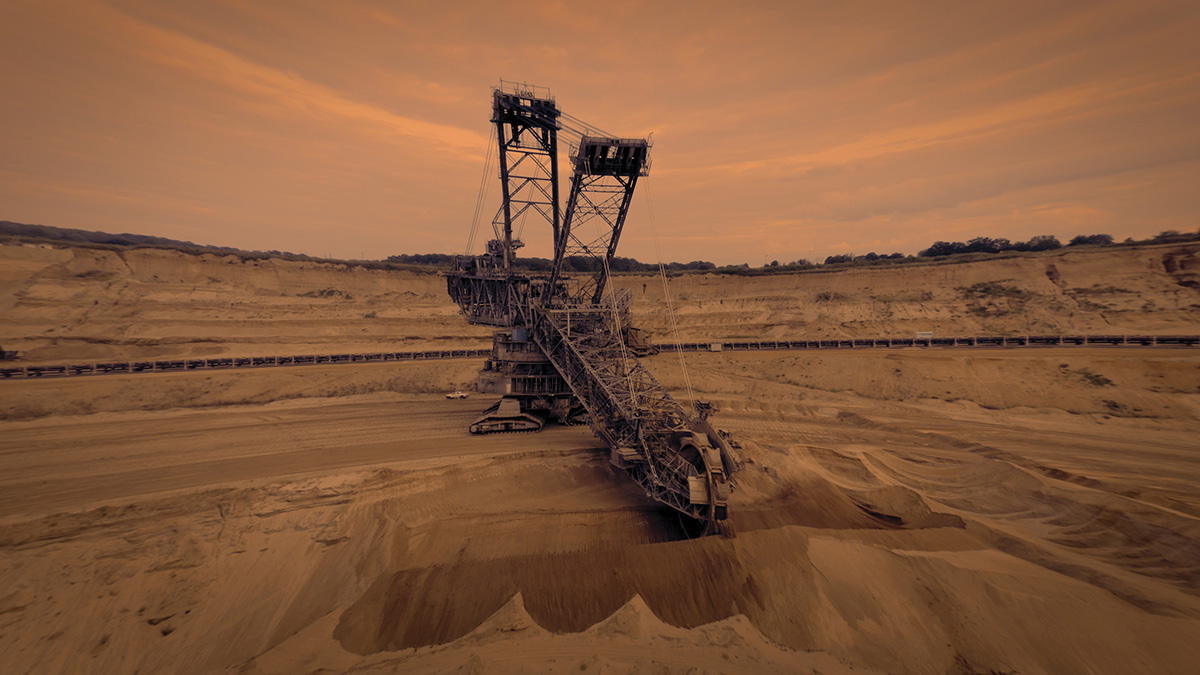
Reliefs is a video work that combines a documentary approach with a story-like narrative. It focuses on spaces shaped by various human activities of extraction and production, with particular emphasis on landscapes made up of slag and other residues. Among the places filmed with a drone are the vast expanse of agricultural greenhouses around Almeria (ES), the gigantic coal mines south of Cologne (DE), slag heaps in the Pas-de-Calais (FR), salt pans in Occitanie (FR), a landfill site for bauxite residues in Provence (FR) or a seawater desalination plant in Andalusia (ES).? These images are complemented by studio shots where models represent other inaccessible places. A scrolling text tells the story of the evolution of a living, mystical and superstitious species, increasingly greedy and self-satisfied. Through the text, the functions and symbolism of the filmed places are reassigned. This obvious parable with the human species allows us to explore these fascinating and terrifying sites, to rediscover those areas on which our food and comfort depend and which we would like never to see. The pulsating music composed by percussionist Will Guthrie accompanies this frenetic progression of the story to the point of saturation, bordering on implosion. From samples of an increasingly rapidly depleted planet, Reliefs offers a fantastic vision teeming with references to the ecological catastrophe we are experiencing.
Elise Marjorie Morin
Catalogue : 2026When The Sun Never Sets | Multimedia installation | 0 | color | 8:0 | France | 2025

Elise Marjorie Morin
When The Sun Never Sets
Multimedia installation | 0 | color | 8:0 | France | 2025
Where the Sun Never Sets est une installation vidéo interactive qui relie trois sites du désert du Nouveau-Mexique, traversés par une histoire du rayonnement à la fois solaire, atomique et cosmique. Grâce à un dispositif d’eye-tracking, le parcours du regard du spectateur s’inscrit en temps réel sur l’image et déclenche des fragments sonores spatialisés : témoignages, voix, traces environnementales ou résonances du paysage. L’image fonctionne comme une cartographie sonore cachée où chaque zone correspond à un point du territoire et à un récit associé. Le regard devient ainsi un outil de dévoilement, révélant des couches invisibles du paysage et mettant en relation Three Rivers, Trinity et les Very Large Array. À la fin de chaque séquence, une capture d’écran du trajet de regard est générée et archivée en ligne avec les entretiens complets, accessibles sur suns.elise-morin.com. Le projet cherche à expérimenter des moyens de lier la puissance du regard à une pluralité de narrations sonores en écho avec un territoire où brillent deux soleils : celui du désert et celui de la première bombe A. Il propose une représentation en résistance, révélant un écosystème vibrant et reliant les réalités irradiées inscrites dans ces lieux.
Élise Morin est une artiste plasticienne vivant et travaillant à Paris. Sa pratique interdisciplinaire explore la relation humaine au visible et la manière dont nos perceptions façonnent notre compréhension des mondes terrestres transformés. Elle développe des projets qui associent recherches artistiques, collaborations scientifiques et enquêtes de terrain, en travaillant régulièrement avec des ingénieurs, des musiciens, des philosophes et des communautés locales. Son travail s'inscrit dans un rapport étroit aux environnements et aux territoires, qu’elle aborde comme des espaces sensibles où s’entrelacent récits, matériaux, technologies et phénomènes naturels. Après des études à l’École nationale supérieure des Arts Décoratifs, elle a passé plusieurs années en Chine et au Japon, où la coexistence entre artisanat, animisme et technologies émergentes a nourri sa réflexion et marqué son approche artistique. Ses œuvres interrogent la place de l’esthétique dans notre rapport au réel et dans la manière dont nous percevons les espaces modifiés par l’histoire, l’industrie ou les transformations environnementales. Élise Morin a exposé en France et à l’international, notamment au Centquatre-Paris, au Jeu de Paume, au Grand Palais, ainsi qu’à Bucarest, Moscou, Pékin et Tokyo. Elle est résidente de la Villa Albertine, où elle a développé le projet Spring Odyssey.
Didier Morin
Catalogue : 2011Fontevrault 82 | Experimental doc. | super8 | black and white | 14:0 | France | 2010

Didier Morin
Fontevrault 82
Experimental doc. | super8 | black and white | 14:0 | France | 2010
En 1982, j?écrivais à Jean Genet pour lui demander s?il accepterait de parler de son temps passé à Fontevrault. J?ignorais à l?époque qu?il n?y avait jamais été emprisonné. Je ne reçu aucune réponse de sa part, et l?autorisation de filmer me fut refusée. Le motif évoqué : l?abbaye était en restauration, donc dangereuse. On me demandait de refaire une demande dans quelques années. Je décidais donc de m?introduire dans l?abbaye sans autorisation. Avec une caméra super 8, un trépied et une lampe de camping, guidé par quelques-uns des derniers prisonniers qui pouvaient se déplacer librement dans l?enceinte, je filmais durant plusieurs jours les lieux, les traces, les inscriptions sur les murs de l?enceinte centrale. Au total 6 galettes de 3 minutes. (Surpris par un gardien, je dus renoncer.) En 2010, j?ordonnais cette matière brute, sans rien y soustraire, ni vraiment la monter, en laissant les reprises de plans, et les hésitations lors du tournage. (Didier Morin)
Né en 1956. Photographe et cinéaste, il enseigne le cinéma à l?école des Beaux arts de Marseille. Crée la revue Mettray en 2001. Il est l`auteur du film Le voyage d`Yves Klein (2007) et d?Un autre voyage mexicain (2010) et de Fontevrault (1979-2010). Il a publié Carnac (Monum Edt) et Les Semelles d?or (La Petite École Comp`Act). Tourne actuellement Dans l?atelier de Jean-Pierre Bertrand.
Maria Morina
Catalogue : 2020Youth Part II | Documentary | hdv | color | 2:13 | Russia | 2019
Maria Morina
Youth Part II
Documentary | hdv | color | 2:13 | Russia | 2019
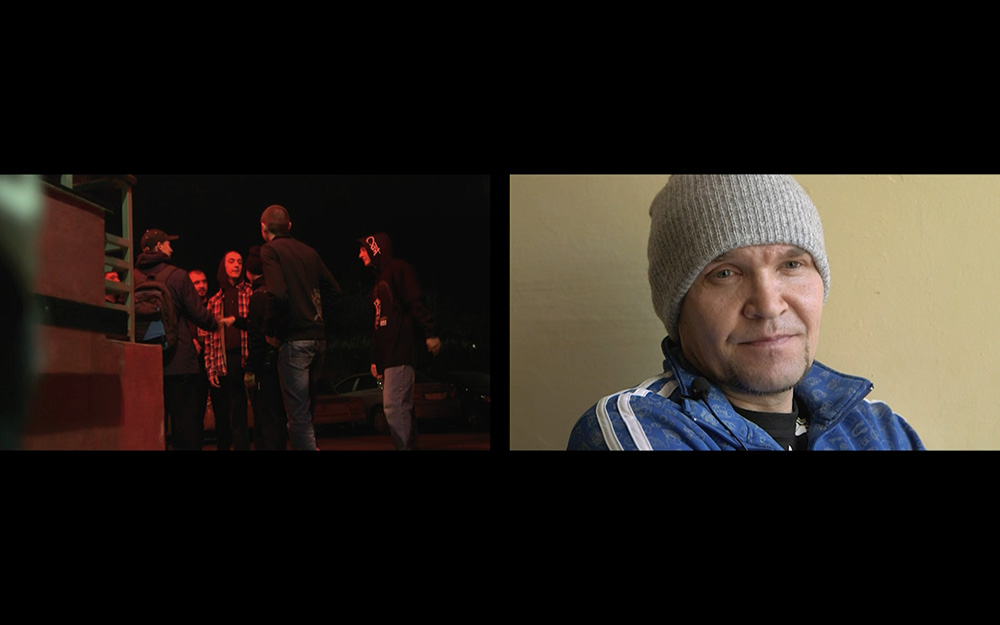
Until the beginning of the 1990s, there were no rap artists in Russia and the Soviet Union. In the middle of the 1990s, a lot of boys throughout Russia started performing hip hop music, many of them had ended up working on factories in the former closed cities. Filmmaker asked several former hip-hop musicians, some still having factory jobs, to remember their old rhythms silently, and paired it with a spontaneous hip hop jam of young people living near the factories of Nizhny Tagil and Yekaterinburg on a second screen. Their voices dissolve like smoke in the back streets of Ural cities, gigantic open-air factories.
Maria Morina is a Russian photographer and filmmaker. She is one of the authors of a cross-media project that took 9 years to produce - Grozny: Nine Cities. It explores specific aspects of the aftermath of the two Chechen wars. It has won several international awards, including Calvados Awards for War Correspondents, 2014, and Luma Rencontres Dummy Book Award Arles, 2017. While working with different mediums on the Grozny: Nine Cities project, Maria has turned to film-making. Maria Morina?s first full-length documentary film, Don?t Press Stop, about Rap musicians in Nizhny Tagil, a gigantic open-air factory in Russia, was released in 2017. It was selected for Lussas Documentary Film Festival, France and Russian Open Documentary Film Festival Artdocfest in 2017. Maria Morina has participated in numerous exhibitions and festivals in Russia and abroad. Her works are held in the Les Rencontres d’Arles and The Open Society Foundation collections.
Catalogue : 2012Nizhny Tagil Youth | Documentary | hdv | color | 5:5 | Russia | 2011
Maria Morina
Nizhny Tagil Youth
Documentary | hdv | color | 5:5 | Russia | 2011
Nizhny Tagil Youth project explores the life of young people in one of the industrial centres, Nizhny Tagil, Russia, located on the virtual border between Europe and Asia. Their aspirations are limited by the paths already determined for them. This industrial city sits amidst the Ural mountains, the natural frontier between Europe and Asia. Of the 362,000 inhabitants, about 70,000 work for UralVagonZavod and 25,000 work for Nizhny Tagil Iron and Steel Plant, part of the Evraz Group, the two main factories located in the town. At around 16 years old, teenagers must make a choice about their employment. The majority ends up working long hours in one of the two plants, some join the small businesses that support these plants and their workers, and the rest remain unemployed. For the young people of the city, growing up within this damaged social landscape, there is a palpable sense of disillusionment. Those who work in the factories are subjected to a monotonous routine. The two hours a day commute added to eight hours on the job leaves them with little time to themselves. And lack of money often prevents them from going out, some feel that they have nothing to do.
Maria Morina is an emerging Russian documentary photographer and filmmaker based in Kiev, Ukraine. Maria Morina was born in Novosibirsk, Russia, in 1982. She graduated from St. Petersburg State University, International Relations, and attended Galperin photojournalism faculty in St. Petersburg and several workshops by Yury Kozyrev/ NOOR, and Bjarke Myrthu/ StoryPlanet organized by Objective Reality Foundation. Ms. Morina has participated in several group exhibitions and installations in Russia, UK, and US. She also worked as a field producer for documentary film Birth Of Nation by Daya Cahen, 2010. Since 2009 Ms. Morina has been working on joint project by three female photographers Grozny: Nine Cities, exploring specific aspects of the aftermath of two Chechen wars, which has been nominated for several international reward. In 2010 Ms. Morina started to work on a personal long term project on Nizhny Tagil youngsters lifestyle. The result of the project will be a series of short documentary films.
Nazli Moripek
Catalogue : 2023Wiederkehrende Erinnerung und dessen zeitliche Wirkung | Multimedia installation | mp4 | color | 11:0 | Germany, Kosovo | 2022
Nazli Moripek
Wiederkehrende Erinnerung und dessen zeitliche Wirkung
Multimedia installation | mp4 | color | 11:0 | Germany, Kosovo | 2022
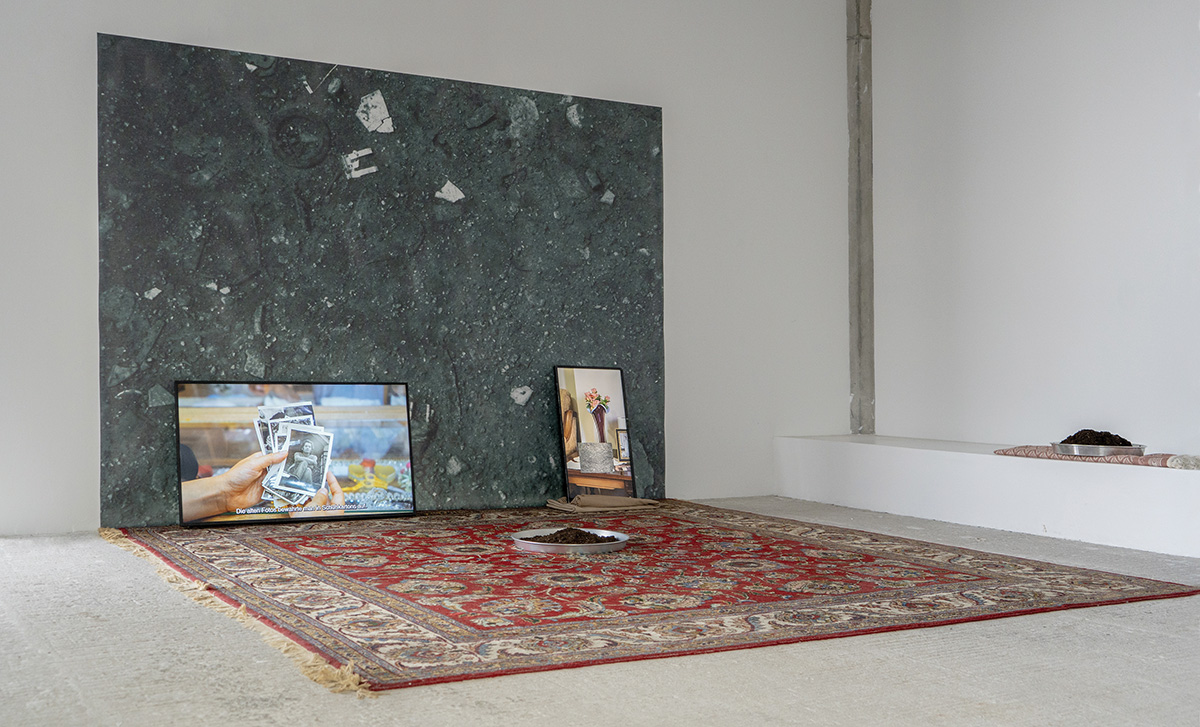
Die Arbeit “Wiederkehrende Erinnerung und dessen zeitliche Wirkung“ befasst sich mit der Darstellung von gesellschaftlichen Beziehungen zwischen Immigration und Erinnerung als materiellem/immateriellem Moment. Im Fokus steht die türkische Minderheit im ehemaligen Jugoslawien bzw. dem heutigen Kosovo. Digitales wie auch analoges Bildmaterial stellen auf unterschiedliche Weise Erinnerung dar, die in Form einer installativen Collage Überschneidung von Kulturen, hybride Identitäten, geopolitische Grenzen und regionale territoriale Identitäten verdeutlichen. Was bleibt als Erinnerung zurück, was vermag ein Gedächtnis zu speichern und welche Räume entstehen, um sich zu erinnern? Erinnerung die stets auch von individuellen Erfahrungen beeinflusst ist, verweist auf gesellschaftliche Strukturen und deren sich auch stets formenden Prozesse.
Nazl? Moripek (*1989, Istanbul) lebt und arbeitet in Frankfurt am Main. Sie studierte Bildende Kunst an der Y?ld?z Universität in Istanbul, an der École supérieure des Beaux-Arts de Bordeaux und an der Hochschule für Gestaltung in Offenbach am Main. In ihrer künstlerischen Praxis nutzt Nazl? Moripek verschiedene Medien, um Formen der Erinnerung und deren zeitliche Verortung und Ausdruck zu erforschen und überführt diese mittels der Darstellungsform der Installation in visuelle Welten, die die verschlungenen und komplexen Schichten diasporischer Formationen und Migrationsströme darstellen. Sie wurde 2019 mit dem DAAD-Stipendium und 2022 mit dem Hessischen Graduiertenstipendium (HAB) der Hessischen Film- und Medienakademie ausgezeichnet.
Morley, Flanagan, Tom
Catalogue : 2012Post-Fordlandia | Experimental doc. | hdcam | color | 19:30 | Ireland, Brazil | 2011
Morley, Flanagan, Tom
Post-Fordlandia
Experimental doc. | hdcam | color | 19:30 | Ireland, Brazil | 2011
?Post- Fordlândia? explores the mythologies surrounding Henry Fords failed utopia ?Fordlândia?. Fordlândia, an an abandoned American town and rubber plantation constructed in 1928 by Henry Ford in the heart of the Amazonian rainforest exists as the most poignant existing monument to Ford?s attempt to export his puritanical model of capitalism and the American way of life into other parts of the world. Through a filmic exploration of this ghost town through the eyes of an other-worldly protagonist, the work contemplates the physical and ideological failure of the exportation of the American capitalist dream into one of the most complex ecological and cultural places on the planet. ?Fordism?, Fords? own term to describe his ideal model of capitalism, has irrevocably altered the development of western society, and whilst Ford?s vision was at once protecting even parental, it was utterly totalitarian. As industrialized processes became increasingly global, the flaws in Ford?s logic began to erode the fabric of his utopian dream. ?Post-Fordlândia? is a thought provoking, contemplative film exploring the failure of the technological utopianism that underpins so much of Capitalism and the assumptions that all societal problems will be solved by endless growth and new technologies.
Megs Morley and Tom Flanagan are artists and filmmakers based in Galway, Ireland, who collaborate on large scale visual art , film and public art projects. Their work is primarily concerned with exploring cultural and political contexts and sites through the expanded use of artist's cinema, cinematic space, documentary, fiction and experimental film. Their approach is multifaceted and experimental and plays with the tropes and forms of non-fiction film, by presenting moments of cinemea verite alongside constructed and fictional elements, whilst avoiding traditional narrative structures of mainstream documentary in order to explore a self-reflexive inquiry into the medium of film, and to complicate potential readings surrounding the documentation of politically complex sites and contexts, thereby creating a criticality on the relationship between images, history and memory. Their work has been shown both nationally and internationally and they are currently working on two feature length experimental documentaries, one of which focuses on Fordlândia.
Wendy Morris
Catalogue : 2010Off the Record | Animation | 35mm | black and white | 5:0 | South Africa, Belgium | 2008

Wendy Morris
Off the Record
Animation | 35mm | black and white | 5:0 | South Africa, Belgium | 2008
Off the Record explores the different experiences and treatment of black and white South African soldiers in Europe during World War I. Two documents form the basis of the film, a war diary kept by the artist?s great-uncle Walter, and a 1917 account by Sol Plaatje of the frustrated attempts of many black South Africans to play their part in the war effort. Points of convergence between these disparate histories are created through the process of animation.
Wendy Morris was born in Namibia (1960), grew up in Johannesburg, South Africa. She studied Fine Art at the university of the Witwatersrand and at the University of South Africa. Now living in Belgium and working towards a practice-based doctorate in the arts at the University of Leuven. She is currently a member of the art-science collaboration Parallellepipeda. Her animated films are made by filming large charcoal drawings that she alters and redraws. Morris exhibits her films, sometimes together with the drawings, in galleries, museums and on festivals. Her films have been selected for competition at such festivals as Clermont-Ferrand, Annecy, Oberhausen, DOK-Leipzig and Fantoche.
Catalogue : 2008Bully Beef | Animation | 16mm | black and white | 6:0 | South Africa, Belgium | 2007

Wendy Morris
Bully Beef
Animation | 16mm | black and white | 6:0 | South Africa, Belgium | 2007
Bully Beef is an attempt to reconnect two histories that continue to be held apart. In 1914 Germany invaded ?little? Belgium. Her allies came to her rescue. It took four years and over forty different nations or ethnic groups ? many of the latter colonised by the allied nations - to hold the German imperialists at bay. The memory of that trauma is kept alive in Belgium. Tourism to sites of battle in the First World War is at an all-time high. Daily busloads of schoolchildren are led around the museums and Commonwealth graveyards in Ieper and the Westhoek. More books are being published in Belgium on the First World War than ever before. There is, in contrast, a dearth of publishing that investigates memories of another invasion concerning the Belgians that occurred only thirty years previous to 1914. Many of the officers and generals honoured for their roles in defending Belgium in the First World War had practised their trade not in Europe but in the acquisition, control and exploitation of a piece of land eighty times the size of the motherland, the Congo Free State. Belgium did to the Congo what Germany was hoping to do to Belgium and other parts of Western Europe. Repelling the German invader with the help of its allies, Belgium continued its invasion of the Congo for a further forty years.
Wendy Morris was born in Namibia (1960), grew up in Johannesburg, South Africa. She studied Fine Art at the university of the Witwatersrand and at the University of South Africa. Now living in Belgium and working towards a (practice-based) doctorate in the arts at the University of Leuven. Her animated films are made by filming large charcoal drawings that she alters and redraws. Bully Beef is her third film. Morris exhibits her films, sometimes together with the drawings, in galleries, museums and on festivals. Her films have been selected for competition at Fantoche, Oberhausen and Annecy festivals.
Catalogue : 2007Taste the World | Animation | 16mm | color and b&w | 4:20 | South Africa, Belgium | 2005

Wendy Morris
Taste the World
Animation | 16mm | color and b&w | 4:20 | South Africa, Belgium | 2005
"Taste the World", a video of four minutes, explores tourist notions of the 'Third World' as a playground for Europe. The title is taken from a tourist brochure in which travellers are exhorted to 'taste the world'. The subtext of the advertisement is that the world is out there for 'you' - for the 'you' of the discerning connoisseur, the 'you' of the Eurostacrat with excess leisure-time. Borderless, the ('third') world is presented as a consumer domain of unlimited choices: culinary, sexual, economic, cultural, etc. The film starts and ends with a meal. Intercut into this narrative is a reference to the journey and homecoming of Sarah Bartman, the South African Khoi woman displayed in Europe in the 1700s as the link between man and ape. She died young, in Paris, and parts of her body were bottled and displayed in the Museum of Man. In 2003 her remains were repatriated to SA where she was then buried.
Wendy Morris is a visual artist born in 1960 in Walvis Bay, Namibia. She is of South African nationality but resides in Belgium. Her studies include a Master in Visual Arts, 2004; an Honours Bachelor of Arts in Art History, 1999; and a Bachelor of Arts in Fine Arts, 1994, all from the University of South Africa.
Bill Morrison
Catalogue : 2023Incident | Experimental doc. | 0 | color | 29:49 | USA | 2023

Bill Morrison
Incident
Experimental doc. | 0 | color | 29:49 | USA | 2023
INCIDENT reconstructs a police shooting in Chicago in 2018, reassembling the event and its immediate aftermath from a variety of viewpoints, including surveillance, security, dashboard, and body-worn cameras as a continuous, synchronized split-screen montage.
Bill Morrison has been called “the poet laureate of lost films” (New York Times, 9/22/21). He makes films that reframe long-forgotten moving images. He has premiered feature-length documentary films at the New York, Sundance, Telluride and Venice film festivals. Morrison had a mid-career retrospective at MoMA in 2014. His found footage opus Decasia (2002) was the first film of the 21st century to be selected to the Library of Congress’ National Film Registry. Dawson City: Frozen Time (2016) was named one of the best films of year by more than 100 critics, and among the best of the decade (2010s) by the Associated Press, Los Angeles Times, and Vanity Fair, among others. In 2021 Morrison became a member of the documentary branch of the Academy of Motion Pictures Arts and Sciences.
Yannick Mosimann
Catalogue : 2025Here are some Images | Experimental film | 16mm | color | 6:4 | Switzerland | 2023
Yannick Mosimann
Here are some Images
Experimental film | 16mm | color | 6:4 | Switzerland | 2023
“Here are some Images” is an short film exploring the interplay between internal and external images, using hand-processed 16mm footage and musings on perception and memory.
Yannick Mosimann is a filmmaker, sound artist, and photographer from Berne, Switzerland. He studied at the University of Applied Sciences and Arts in Lucerne, where he completed his Bachelor’s degree with the short film "How I Disappeared". The film has been screened at various film festivals worldwide. Mosimann further pursued his education by completing his Master’s degree in Contemporary Arts Practice at the Bern University of the Arts. Mosimann's body of work encompasses films, video/audio installations and collaborations with various artists as a filmmaker and musician. His artistic focus lies in intuitive processes, sensorial experiences and the reimagining of narratives. Themes explored in his work include the anthropocene, nature, cosmology, darkness and human perception. In early 2022, Mosimann released his first feature-length film titled "I Have Not Been Afraid of Going Blind for a Long Time". The film received widespread acclaim and was showcased at national and international film festivals as well as art spaces. Currently, Mosimann is distributing his feature-length documentary titled "Normal Love".
Catalogue : 2023I HAVE NOT BEEN AFRAID OF GOING BLIND FOR A LONG TIME | Experimental film | 16mm | color | 134:0 | Switzerland | 2021
Yannick Mosimann
I HAVE NOT BEEN AFRAID OF GOING BLIND FOR A LONG TIME
Experimental film | 16mm | color | 134:0 | Switzerland | 2021
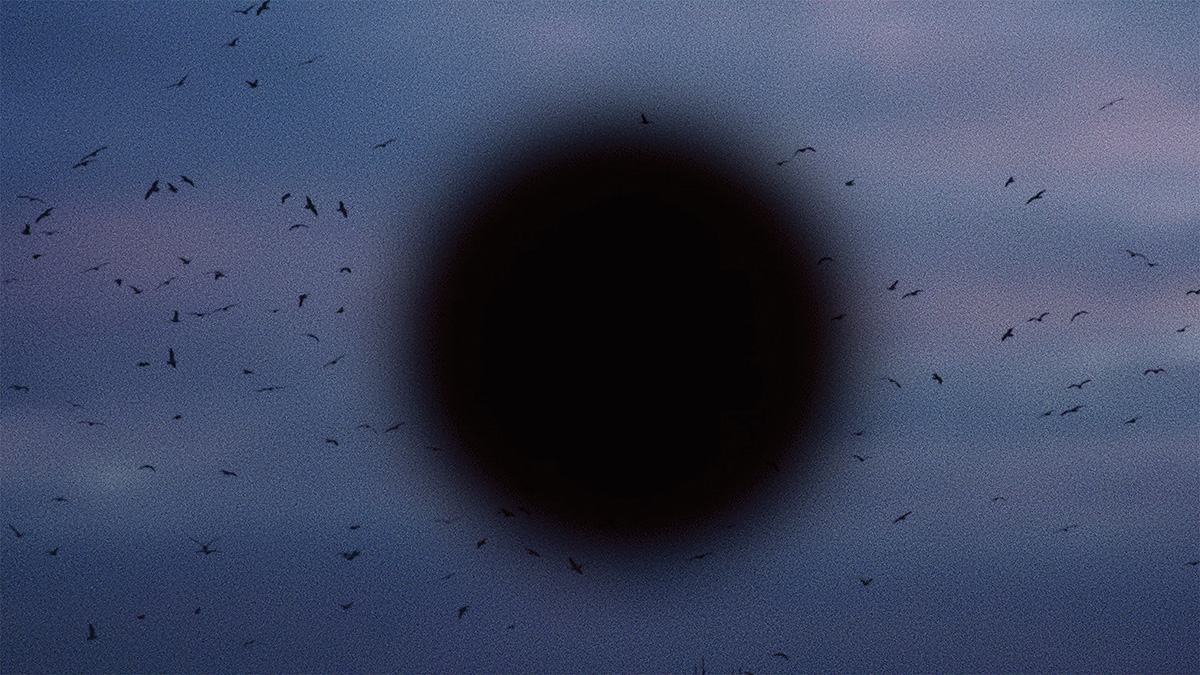
A flock of starlings swooshed over me today. In my mind I repeat the sound over and over again, while I watch the film footage. The filmmaker captures his environment with the camera, fearing he might be losing it more and more. Strict rules about using the entire clip length and its original audio track inform the editing process. The tableaus and their insistence in duration create a pull into an increasingly isolated state of perceiving the outside world in its unspectacular yet strangely unfamiliar intensity.
Born 1989 in Bern, Switzerland. Filmmaker, sound artist and photographer. His work includes several films and video installations, as well as collaborative work as a filmmaker and musician with a variety of artists. Yannick Mosimann's work focuses on intuitive processes and sensory experiences. He deals with themes such as the Anthropocene, nature and human perception. He lives and works in Bern.
Yannick Mosimann
Erik Moskowitz, Amanda TRAGER
Catalogue : 2009Cloud Cuckoo Land | Video installation | 0 | color | 16:27 | USA | 2008
_1.jpg)
Erik Moskowitz, Amanda TRAGER
Cloud Cuckoo Land
Video installation | 0 | color | 16:27 | USA | 2008
Cloud Cuckoo Land (2008) is a collaboration between Erik Moskowitz and Amanda Trager. The title of the piece, Cloud Cuckoo Land is taken from the Aristophanes? play The Birds. In the 4th Century BC, the notion of utopia was already in play?and put into doubt. The narrative encompasses a family?s move to a contemporary commune. The central character, Bianca, after years of fantasizing about the ideal way to raise her child and with fixed, romantic notions of the ?best? way to live, is confronted by her own intolerance and inability to integrate with the community. The video?s narrative exploits conventional cinematic devices (shot/reverse shot, music cues) and is meant for exhibition in gallery and museum space as well as in cinematic space. Cloud Cuckoo Land critiques assumptions too easily relied upon when determining the difference between public and private space. The prescribed boundary between art space and cinema space functions as a model of the larger issue whereby artificial and arbitrary boundaries are used to define conventions of personal and societal comfort and safety.
Erik Moskowitz uses the relationship between cinema space and gallery space as a point of departure for installation and film. Amanda Trager fuses painting, sculpture, and installation with first-person prose narrative. The artists? involvement with fractured narrative or anti-narrative is of long-standing in their independent practices. For Moskowitz it dates back to childhood, when Spalding Gray invited him to perform in the Wooster Group?s Sakonnet Point. His work with Spalding continued for the next eight years; his relationship with Joan Jonas dates from this period. More recently, Moskowitz has been known for music/video installations based on excerpts from literary sources. Trager, focusing on rant-like texts and character-creation in painting, sculpture and installation for over ten years, most recently has been making work embodying lopsided ?conversation? between mismatched players. Both live and work in New York City and Canada.
Erik-amanda Moskowitz-trager
Catalogue : 2012QUEER VOICE | Video | | color | 5:12 | USA | 2010
Erik-amanda Moskowitz-trager
QUEER VOICE
Video | | color | 5:12 | USA | 2010
In response to an invitation to ?describe the queer voice,? artists Erik Moskowitz + Amanda Trager created this video, a whimsical portrait of an artist-couple.
Our collaborative work has been exhibited and screened internationally at venues that include Centre Pompidou, Jeu de Paume, Paris (2008-10); Reina Sofia, Madrid (2009); Haus der Kulturen der Welt, Berlin (2009); Participant, Inc. and 303 Gallery, NYC (2009). The single-channel component of our newest work premiered at the Rotterdam Film Festival and won Grand Prize for Short Film at IndieLisboa (2011). Art residencies include Montalvo Arts Center (2006) and Headlands Center for the Arts (2011), both in California. Grants include a NYFA Fellowship in Video (2008) and a NYSCA Distribution Grant (2009).
Joshua Mosley
Catalogue : 2017Jeu de Paume | Animation | hdv | color | 2:52 | USA | 2014
Joshua Mosley
Jeu de Paume
Animation | hdv | color | 2:52 | USA | 2014
Jeu de Paume depicts a court tennis match at the Château de Fontainebleau, France, set in 1907. The stop-motion animation, filmed with a robotic hand-held camera, reflects the asymmetrical design of the court and the irregular rhythm of the game.
Joshua Mosley is Professor of Fine Arts in the School of Design at the University of Pennsylvania. He received his M.F.A. and B.F.A. from The School of the Art Institute of Chicago. Joshua is a recipient of fellowships including the Joseph H. Hazen Rome Prize, the Pew Fellowship in the Arts, and the Louis Comfort Tiffany Foundation Award. His work has exhibited and screened at the 2014 Whitney Biennial, the 2007 Venice Biennale, the Wexner Center for the Arts, the Museum of Modern Art, NY, the Modern Art Museum of Fort Worth, the Museum für Gegenwartskunst in Basel, Switzerland, the Art Institute of Chicago, the Bruce Museum, the Reina Sofia in Madrid, the Philadelphia Museum of Art, Donald Young Gallery, the Indianapolis Museum of Art, the Fabric Workshop and Museum, the Institute of Contemporary Art Philadelphia, the SITE Santa Fe Eighth International Biennial, and the Museum of Contemporary Art San Diego.
Vladimir Moss (moseykin)
Mehedi Mostafa
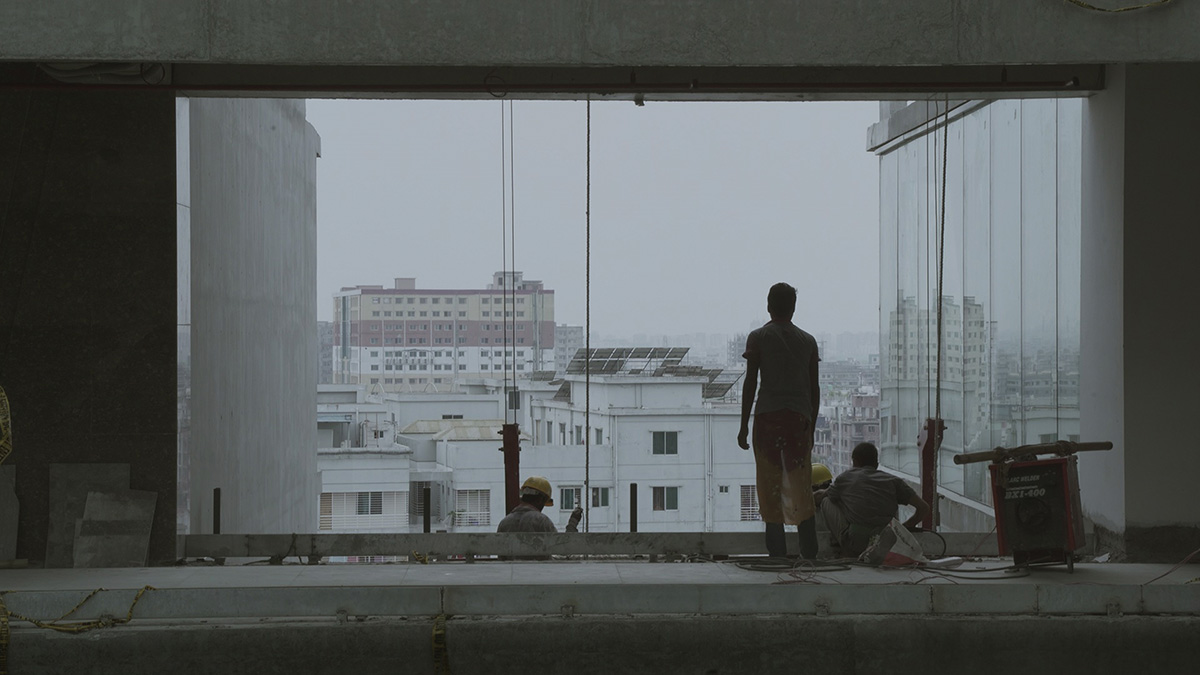
Catalogue : 2023Fantasy in a concrete jungle | Documentary | hdv | color | 14:55 | Bangladesh | 2022
Mehedi Mostafa
Fantasy in a concrete jungle
Documentary | hdv | color | 14:55 | Bangladesh | 2022
An essay film on an unplanned city, Dhaka, from the point of view of an off-screen architect. The architect travels from the loud city to the silence of the remote village, encounters people, incidents and landscapes. The film is a meditation on the nostalgia for the rural past jutted against the urban chaos and a reflection on finding home in the urbanized present.
Born in Bangladesh, Mehedi Mostafa studied architecture in Dhaka before joining a Mumbai based film school Whistling Woods Int. in India. He finished his diploma in filmmaking with direction specialization in 2017. Currently he?s working on a feature documentary project called “Making Places” and developing a fiction feature. He attended Docedge Kolkata, Uniondocs summer documentary lab and Locarno south Asia industry academy. His latest short documentary FANTASY IN A CONCRETE JUNGLE (2022) was selected at Clermont-Ferrand international short film festival and won the Lab student prize.
Mostra, Gabriela MONROY, Caspar STRACKE
Catalogue : 2006Kuleshov sukiyaki | Experimental video | dv | color | 2:58 | Mexico, USA | 2004

Mostra, Gabriela MONROY, Caspar STRACKE
Kuleshov sukiyaki
Experimental video | dv | color | 2:58 | Mexico, USA | 2004
"Kuleshov Sukiyaki is based on the music piece "Systole No 2" from INTERSTICES (2000) by Terre Thaemlitz. It uses this music collage as a grid for the montage of a particular set of found images. In the music piece ?Systole No 2?, Thaemlitz deconstructed a funky 70`s pop song with the idea to extract those music passages where no vocals are being sang. These are usually the pop song segments that hardly anyone pays attention to. Thaemlitz therefore distills the background radiation of the song, transforms it into an arrhythmic instrumental piece, not without leaving some traces of the singer`s voice - his inhalations and exhalations, "suggesting emotional, physical and/or sexual exasperation, and occasionally resulting in the whispering of new words?? (T.T.) Analog to this "systolic" sound collage Kuleshov Sukiyaki contains a patchwork of clips from 70`s erotica and soft porn movies which highlight similar emotional moments, including the befores and afters of orgasm scenes. It features a variety of highly aesthetic cinematography (in films of Radley Metzger, Paul Morrisey) as well as stylistic somersaults. In the eyes of their producers and occasionally even directors these elements are exclusively created for the support or exaggeration of pure lust and sexual charge, that their creators hope to have embedded in these scenes. This over-saturation becomes apparent even in single images, after being taken out of their context. (Mostly close-up`s of actors gazing at their partner.) In this assembly of images the energy fields are redirected, using their magnetic charge in order to fuse together associative image elements of entirely different films. In addition, it also applies the oldest experiment in associative editing, the famous Lev Kuleshov effect, while featuring a non- linearity that could be compared to the ?now legendary? chopped film-with-sukiyaki dish by experimentalist Tony Conrad."
m o s t r a is a duo of video artists Gabriela Monroy and Caspar Stracke. They gather and transform found images according to single themes of social, architectural and political nature. Harvesting the net as well as recycling found footage, they recontextualize raw content in which images sequences are treated as text re-edited. Occasionally this also happens vice versa: text is transformed into imagery--literally, though ASCII code. m o s t r a `s fast-paced hybrid language of juxtaposed imagery and animated shapes allow a constant exchangeability of visual and textual signifiers, creating new meaning out of re-used images. Both, Monroy and Stracke have produced several video installations and single channel works that have been shown in the US, Mexico, Brazil, Europe and Japan. Their work has been published on the Eyewash DVD compilation by forward-motion theater. Stracke?s single channel work is in distribution of video data bank, e-film workshop, Oberhausen Festival and Lightcone, Paris.
Santiago Mostyn
Catalogue : 2019The Warming Plateau | Experimental film | 16mm | color and b&w | 12:0 | United Kingdom, Trinidad & Tobago | 2017
Santiago Mostyn
The Warming Plateau
Experimental film | 16mm | color and b&w | 12:0 | United Kingdom, Trinidad & Tobago | 2017
The Warming Plateau is a film recorded on Tobago, an island unique among the former British West Indies in that much of its West African heritage survived the obliterating effects of slavery and exists in vibrant tradition long into the present day. One segment of the film recalls the legend of Gang Gang Sarah, the ‘African slave witch’ who, wishing to return to her homeland, climbed the sacred Silk Cotton tree and tried to fly. But Gang Gang Sarah did not realise she had lost her powers of flight after eating salt, and fell to her death. The other segment of the film shows four men cutting their way through the jungle, making measurements, calling out to each other, working on something that comes into focus as a kind of land claim or marking of territory. The film as a whole is a portrait of the island as a sentient being, showing sites of past and present exploitation.Â
Santiago Mostyn – born in San Francisco but with strong ties to Grenada, Zimbabwe and Trinidad & Tobago – currently lives in Sweden. Mostyn works and lives between these cultures, often creating a context for reflection on privilege, inclusion and utility. With his films, photographs and installations, he sets up a framework to test how wide or narrow the apparent divide is between different social spheres. He employs an intuitive creative process and points to a knowledge and history grounded in the body rather than the rational mind. Through his work, Mostyn creates a balance between intuition and reason, dreams and waking states, and offers the audience a fresh way of seeing and contextualizing their everyday experiences. Mostyn is a graduate of Yale University, Städelschule in Frankfurt, and the Royal Institute of Art in Stockholm. He is currently co-curator of “The Moderna Exhibition 2018: With the Future Behind Usâ€, Moderna Museet’s quadrennial survey of contemporary art in Sweden.
Boynayel Mota
Catalogue : 2025Kongo Pa Kasimiro | Documentary | 4k | color | 73:35 | Dominican Rep. | 2022

Boynayel Mota
Kongo Pa Kasimiro
Documentary | 4k | color | 73:35 | Dominican Rep. | 2022
Casimiro Minier, former captain of the Congo tradition of Villa Mella and master craftsman of Congo musical instruments, serves as our connection to a legacy spanning 110 years. Through him, we delve into the knowledge passed down orally through generations, linking back to Mother Africa. Kongo for Kasimiro is a cinematic proposal capturing the Congo tradition in its everyday essence, celebrating life and the transition to death. Here, death is viewed as a passage to the life of the ancestors, whose presence is felt through the drum and spirituality. Kongo for Kasimiro also serves as an anthropological and ethnographic work from the perspective of director Boynayel Mota, who spent 20 years with Master Casimiro. This artistic material is aimed at educating and inspiring new generations.
Boynayel Mota is a Dominican filmmaker, musician, producer, and activist who focuses on the ancestral traditions of the Dominican Republic and the Caribbean. His work primarily highlights Afro-indigenous communities, and he has collaborated with several prestigious institutions, including the Museum of the Dominican Man, the National Museum of the American Indian, and the Smithsonian. Mota is also the founder of Yukayeke Taiguago Kiskeya, a space dedicated to the preservation and dissemination of Taíno culture, which organizes the Anakaona Taíno Festival of Kiskeya
Carlos Motta
Catalogue : 2015NEFANDUS | VIDEO | hdv | color | 13:4 | Colombia | 2013
Carlos Motta
NEFANDUS
VIDEO | hdv | color | 13:4 | Colombia | 2013
In Nefandus two men travel by canoe down the Don Diego river in the Sierra Nevada de Santa Marta in the Colombian Caribbean, a landscape of “wild” beauty. The men, an indigenous man and a Spanish speaking man, tell stories about pecados nefandos [unspeakable sins, abominable crimes]; acts of sodomy that took place in the Americas during the conquest. It has been documented that Spanish conquistadores used sex as a weapon of domination, but what is known about homoerotic pre-Hispanic traditions? How did Christian morality, as taught by the Catholic missions and propagated through war during the Conquest, transform the natives’ relationship to sex? Nefandus attentively looks at the landscape, its movement and its sounds for clues of stories that remain untold and have been largely ignored and stigmatized in historical accounts.
Carlos Motta's interdisciplinary artistic practice includes the making of video essays, documentaries and online video archives. His early video Letter to My Father (Standing by the Fence) (2005) narrates the experience of living and working in New York City at the aftermath on 9/11 and focuses on the personal and political intersections of immigrants within that context. Motta is interested in questioning the structures of power that control and regulate civic life as well as hegemonic construction of historical narratives. One of his most recognized projects is We Who Feel Differently (2012), a comprehensive video archive of interviews with dozens of queer subjects that speak about the forty years of gay, lesbian, bisexual, trans, intersex and queer activism from a variety of social perspectives. The installation was first presented in a solo exhibition at New York's New Museum in 2012 to great acclaim. Motta's most recent video works Nefandus Trilogy will have its World Premiere at the 2014 International Film Festival Rotterdam's Tiger Awards Competition. Composed of three short films, Nefandus (winner of Catalonia Hotels Award for Best Video at LOOP, Barcelona, 2013), Naufragios and La visión de los vencidos, the trilogy exposes the imposition of the category `sexuality` onto indigenous cultures in the Americas during the Conquest and throughout the colonial period, based on moral and legal discourses of sin and crime. These works will also be presented at the First International Biennial of Contemporary Art of Cartagena de Indias in February.
Carlos Motta
Shana Moulton